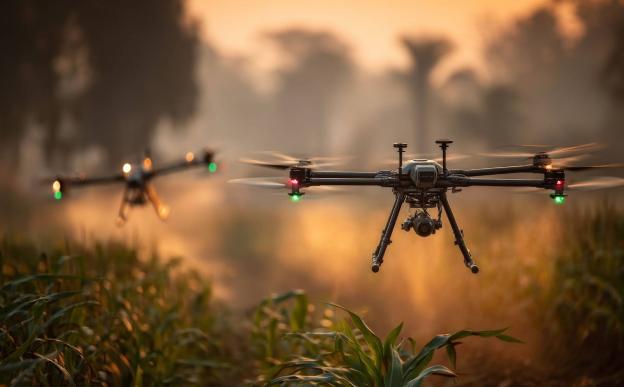
Novel scheme by IIT Bombay researchers to control drones can enable complex formation flying using only camera data, without GPS or inter-drone communication.

Archives

A team of scientists from Rice University, Texas, USA, Indian Institute of Science (IISc), Bengaluru, Bruker Nano Surfaces, Minnesota, USA and Indian Institute of Technology Gandhinagar, Gujarat have developed a new way to exfoliate a 2 dimensional metal sheet, few layers o even up to a single layer of atoms thick.

It’s the 20-20 cricket world cup finals. Indian vs. Pakistan! India need 4 runs to win! Yuvraj Singh swings his bat and it’s a…! Blank! Oh no! A power cut!

The superbug series: Part 1. The first of a three part series talks about antibiotic resistance showed by disease causing bacteria, its reasons, the problems associated with antibiotic resistance and the severity of the issue in India.

Scientists at Indian Institute of Technology Indore, Indore have developed L-lyso—a novel water soluble, fluorescent dye which can permeate the membranes of lysosomes, marking them for future tracking and imaging.

Scientists at Indian Institute of Technology Indore, Indore have developed L-lyso—a novel water soluble, fluorescent dye which can permeate the membranes of lysosomes, marking them for future tracking and imaging.

Researchers from the Indian Institute of Technology, Bombay show us how basic research is helping India inch closer to the dream of hypersonic travel.

Scientists from Indian Institute of Science (IISc) and Jawaharlal Nehru Centre for Advanced Scientific Research (JNCASR) have demonstrated a new type of 3 dimensional imaging platform, called iLIFE, that provide detailed images of biological specimen flowing in a fluid.

Dogs have been introduced in various places across the world, where they were not found before by humans. In a recent study, researchers from the Ashoka Trust for Research in Ecology and the Environment study how dogs affect the local biodiversity.

A team of scientists from Academy of Scientific and Innovative Research (AcSIR), Council of Scientific and Industrial Research-National Chemical Laboratory (CSIR-NCL) and Indian Institute of Science, Education and Research Kolkata (IISER Kolkata) have studied the formation of 2 Dimensional Covalent Organic Frameworks (COF)- organic solids bound together by covalent

Researchers from National Institute of Technology, Durgapur and Indian Institute of Technology Kharagpur in West Bengal, with support from Department of Biotechnology, Government of India,have shown that the one way to efficiently deal with oil sludge, is to cultivate suitable microbes using nutrients, which then disintegrate the contaminants in the sludge.

Search Research Matters