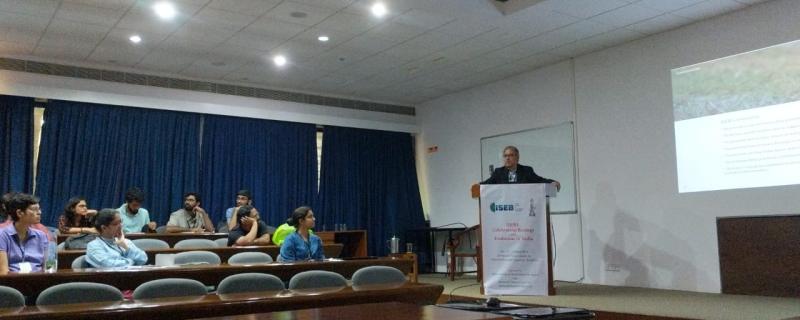
The Indian Society of Evolutionary Biologists (ISEB), an independent consortium of researchers and faculty working on evolutionary biology in India, is holding its first conference on the 24th and 25th of October, 2019, at the Jawaharlal Nehru Centre for Advanced Scientific Research (JNCASR), Bengaluru. The two-day meeting is themed around ‘Celebrating Ecology and Evolution in India’. It is bringing together eminent researchers and students across the country, who are actively involved in research on evolutionary biology.
Archives

“முன்னியது முடித்தனம் ஆயின், நன்னுதல்,
வருவம்’ என்னும் பருவரல் தீர,
படும் கொல் வாழி நெடுஞ்சுவர்ப் பல்லி…….”,
169 - நற்றிணை
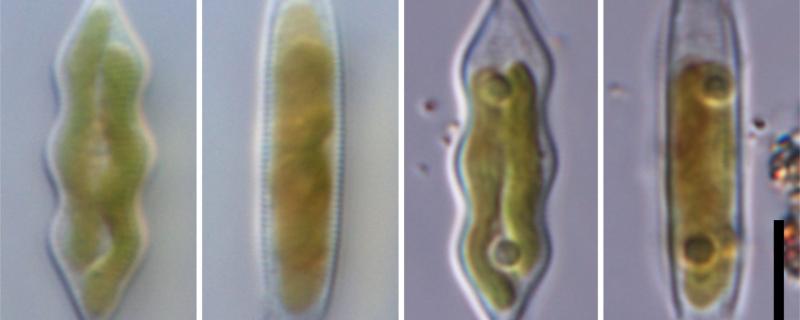
In a recent study, researchers from Agharkar Research Institute, India, Harbin Normal University, China and the University of Colorado, USA, have described a new genus of diatoms called Kulikovskiyia. Diatoms belonging to this genus are currently found only in the Western Ghats of India and Hainan Province of China. The study, funded by the Science and Engineering Research Board, was published in the journal Phycological Research.

ಈ ವರ್ಷದ ಬೇಸಿಗೆ ಕಾಲ, ಮಳೆಗಾಲದ ಅವಧಿಯಲ್ಲಿ ಭಾರತದ ಅನೇಕ ಪ್ರದೇಶಗಳು ಬರಗಾಲ ಮತ್ತು ಪ್ರವಾಹಗಳಿಂದ ತತ್ತರಿಸಿದವು. ನೀರಾವರಿಗಾಗಿ ಮಳೆಯ ಮೇಲೆ ಅವಲಂಬಿತವಾಗಿರುವ ದೇಶದಲ್ಲಿ (ವ್ಯತಿರಿಕ್ತ) ವಿನಾಶಕಾರಿ ಹವಾಮಾನದಿಂದಾಗಿ ಉಂಟಾಗುವ ಬೆಳೆಗಳ ನಷ್ಟವು ರೈತರಿಗೆ ತೊಂದರೆ ಉಂಟು ಮಾಡಿದೆ.

The use of vaccination for preventing diseases has had the most profound effect on human health and quality of life. Despite this, anti-vaccination movements are gaining popularity in recent years, especially in high income countries with historically near universal vaccine coverage, like the USA. Consequently, cases of diseases like measles have seen a 30% rise globally. Vaccine hesitancy has been declared one of the top ten threats to global health by the WHO in 2019. In times like these, what if science showed some added benefits of vaccination besides the obvious? A recent set of studies by a team of international researchers, led by those at the Center for Disease Dynamics, Economics & Policy (CDDEP), Washington DC and New Delhi, have shown that vaccines can have other unintentional positive effects.
Prof Bhaskaran Muralidharan and Dr Alestin Mawrie of the Indian Institute of Technology Bombay have researched a specific category of two-dimensional nanomaterials, called semi-Dirac materials. Their theoretical studies show that it is possible to engineer semi-Dirac materials to make optical filters and efficient thermoelectric nanodevices.

Prof Subimal Ghosh, Professor at the Department of Civil Engineering, Indian Institute of Technology Bombay (IIT Bombay), has been awarded the Shanti Swarup Bhatnagar Prize 2019 by the Council of Scientific and Industrial Research (CSIR). This award recognises his significant contributions to our understanding of how land surface processes influence the Indian monsoon, as well as for improving regional monsoon simulations and predictions.
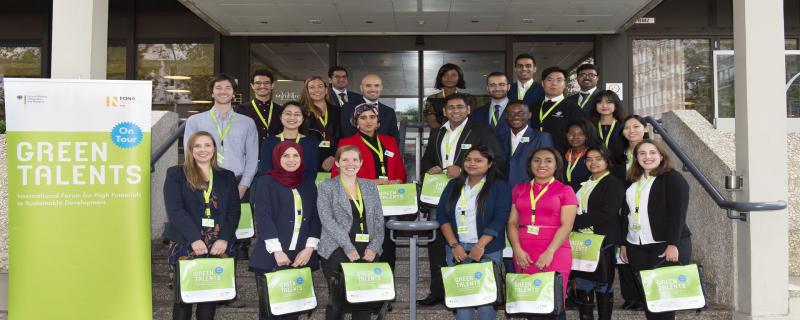
In a press announcement, the Green Talents programme, held under the patronage of the Federal Ministry of Education and Research, Germany, has announced this year’s 25 winners from all over the word. These awardees, called ‘Green Talents’, will travel to Germany in late October to attend the Science Forum for talented junior researchers from the field of sustainability science.

Projected to be the third fastest-growing city in the world, Bengaluru's transformation from being the 'Garden City' to the 'Silicon Valley of India' has made it the modern face of the Indian economy. But all this development has come at a cost with the city losing 89% of its green cover in just forty years. Once known for its cool climate, it is now infamous for its horrible traffic and concrete buildings. Middle-class ghettos and affluent gated communities have replaced the famed lakes, and the gardens have been cleared for IT parks. Thanks to the exponential growth, poor urban planning and corruption, experts believe that the city is going to be unlivable in a few years. In a recent study, published in the journal Remote Sensing Application: Society and Environment, researchers at the Department of Atmospheric and Environmental Sciences, University of Albany, State University of New York, have explored the impact of increased urbanisation on Bengaluru.

Human Immunodeficiency Virus (HIV) infections are one of the most severe public health problems in India, with approximately 21 lakh HIV infected people reported in 2017. Sex workers, men who have sex with men, transgender people, and people who inject drugs are at a higher risk of contracting the virus. Scientists across the world are exploring the possibility of a drug that can be taken daily to keep HIV infections at bay, which could help in reducing the spread of the disease and an overall prevalence, besides acting as a preventive measure for those under high risk. In a recent study, published in the journal Clinical Infectious Disease, researchers evaluate if such a drug can act as a preventive measure in a developing country like India.