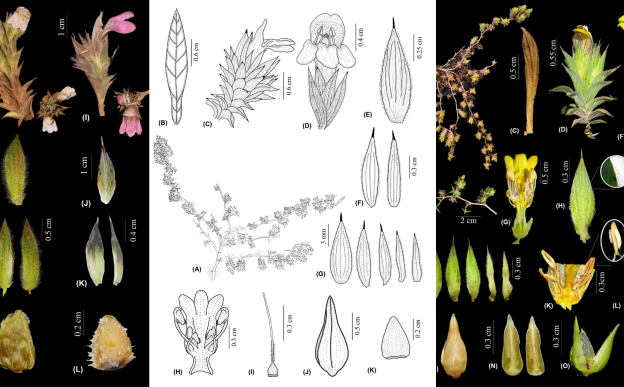
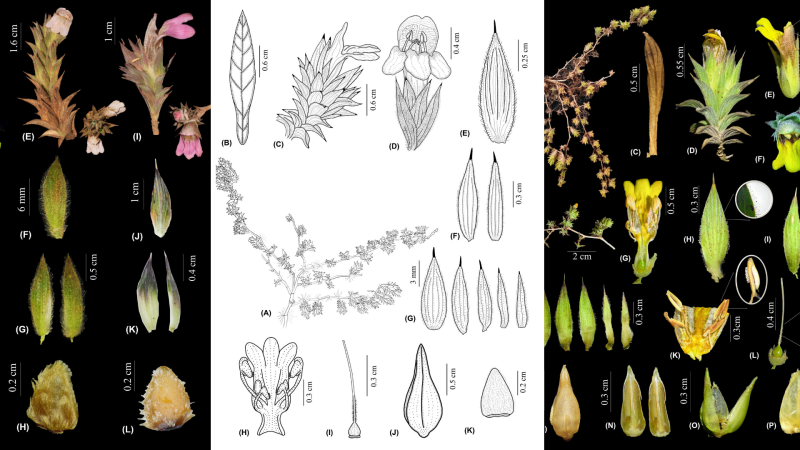
A team of researchers has discovered a new species of wildflower tucked away on the sun-drenched, rocky plateaus of Maharashtra’s Konkan region. The plant, named Lepidagathis konkanensis, was identified in the Ratnagiri district by a group of botanists from Parulekar College of Arts, Commerce and Science, National Institute of Agriculture Sciences, Republic of Korea, and other local colleges in Maharashtra. The discovery, recently published in the Nordic Journal of Botany, highlights the unique biodiversity of the Western Ghats, a global hotspot for rare and endemic life.
The team first encountered the plant during a floristic survey of the region’s lateritic plateaus, harsh, iron-rich environments that often host specialised life forms. To prove it was a new species, the team conducted a botanical probe, comparing the plant’s physical traits to those of known species and performing molecular phylogenetic analysis, which uses DNA to map evolutionary relationships. This DNA testing enabled the researchers to build a genetic family tree, confirming that the plant belonged to a distinct lineage separate from its closest relatives.
What sets Lepidagathis konkanensis apart is its striking appearance and compact size. While many of its cousins have pink or pale flowers and long flowering spikes, this new species features bright yellow, two-lipped blossoms and very short, dense flowering heads that measure only about two centimetres. It also has smaller seeds and a shorter style—the part of the flower that receives pollen—than its closest relatives. These physical differences, combined with its unique genetic markers, provided the smoking gun needed to declare it a new discovery.
The plant’s name, konkanensis, serves as a tribute to its home; the specific epithet (the second part of a scientific name) refers to the Konkan region of Maharashtra where it was found. This area is geographically isolated by the Arabian Sea to the west and the Sahyadri Mountains to the east, creating a cradle for evolution where unique species can develop in isolation. Despite the excitement of the find, the researchers have raised concerns about the plant’s future. Lepidagathis konkanensis is currently only known to exist in a small area of less than 65 square kilometers. Because its habitat is threatened by forest fires, tourism, and expanding agriculture, the scientists have recommended it be classified as Data Deficient by the International Union for Conservation of Nature (IUCN). They hope this discovery will lead to further studies and better protection for the fragile ecosystems of India’s rocky plateaus.