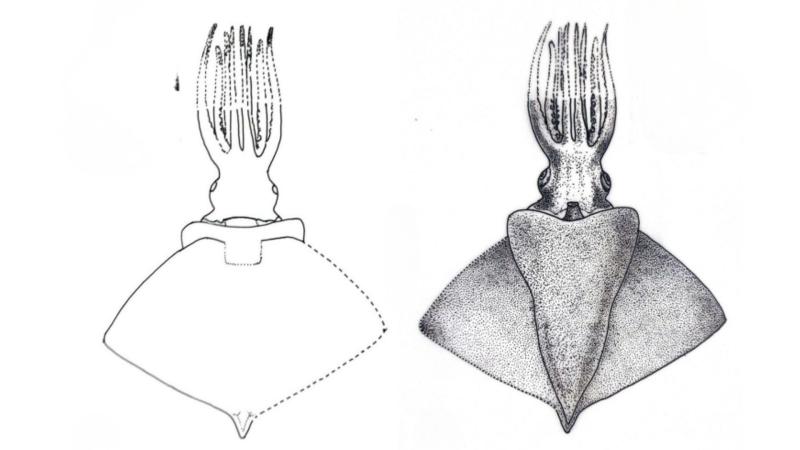
Dorsal and ventral view of Taningia silasii. Credit: Authors, https://doi.org/10.1007/s12526-025-01576-3
Researchers have identified a new species of giant deep-sea squid, Taningia silasii, from the southeastern Arabian Sea. Their discovery confirms that the genus of these large, elusive cephalopods is far more diverse than previously understood. The discovery, made by researchers from the ICAR-Central Marine Fisheries Research Institute and Amrita School for Sustainable Futures, represents only the second formally recognised species in the Taningia genus, which is known for its large size and characteristic light-producing organs (photophores) on its arms. The species name, silasii, is a tribute to the late Dr E.G. Silas, an eminent Indian marine biologist whose pioneering work significantly advanced the understanding of cephalopods, which include squid, octopus, and the nautilus, in Indian waters.
The most compelling evidence for the new species, nicknamed the Indian octopus squid, came from molecular analysis. Genetic sequencing of two mitochondrial genes showed a substantial divergence of over 11% from Atlantic Ocean lineages of its only previously confirmed relative, Taningia danae. This genetic gap strongly supports its recognition as a distinct species. Beyond the DNA, scientists identified several key physical differences. T. silasii has a reduced number of gill lamellae, which are tiny leaf-like structures on the gills. T. silasii had just 26 gill lamellae compared to the 38 to 44 found in T. danae. It also possesses a uniquely oval-shaped funnel-mantle locking cartilage and distinct morphological features in its beak, including a broadened wing on the lower beak.
The single specimen used for the description was a female, measuring 415 mm (over 16 inches) in dorsal mantle length and weighing 1.7 kilograms. It was collected in March 2024 by a deep-sea commercial trawler operating in the fishing grounds off Kollam, Kerala, at a depth of approximately 390 metres. It has been deposited in the Marine Biodiversity Museum of CMFRI, Kochi.
For a long time, the genus Taningia was considered to contain just one species, T. danae, which was thought to be distributed globally. However, recent molecular systematics studies have increasingly suggested that many deep-sea species previously considered cosmopolitan and widespread are actually multiple distinct species. The discovery of T. silasii in the Indian Ocean, a region historically understudied compared to the Atlantic and Pacific, reinforces the view that deep-sea biodiversity remains vast and largely hidden.
This article was written with the help of generative AI and edited by an editor at Research Matters.