Nearly 2.5 billion years ago, a subterranean encounter took place beneath what is now Northwest India, and researchers may have finally decoded the clues left behind in the stone. Researchers from the Indian Institute of Technology (IIT) Roorkee, Kumaun University, and the CSIR-Central Building Research Institute have discovered that the Berach granitoids, some of the region’s oldest and most stable rocks, formed through a complex mixing of two distinct magma types.
The team were studying the Aravalli craton, a massive piece of Earth’s ancient crust in Northwestern India extending through Gujarat, Rajasthan, Haryana, and Delhi. Their study uncovered evidence of hot, dark mafic (igneous rock rich in magnesium and iron) magma from deep within the mantle, injecting itself into a cooler, lighter felsic (igneous rock rich in feldspar and quartz) magma near the surface. This look into the Neoarchean era (2.8 to 2.5 billion years ago) provides clues for how the ground we stand on today first began to stabilise and grow.
Did You Know? The rocks studied in the Aravalli region are approximately 2.44 billion years old. That means they have existed for more than half the total age of the Earth itself! |
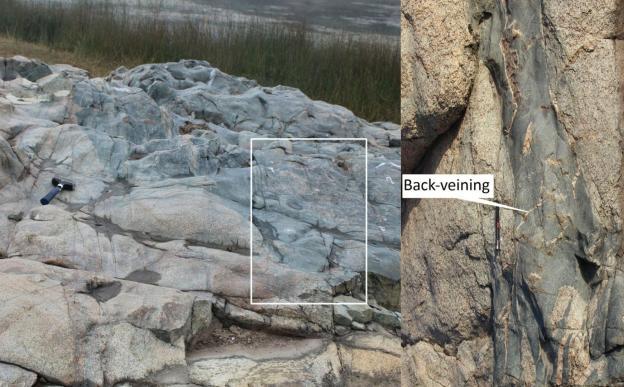
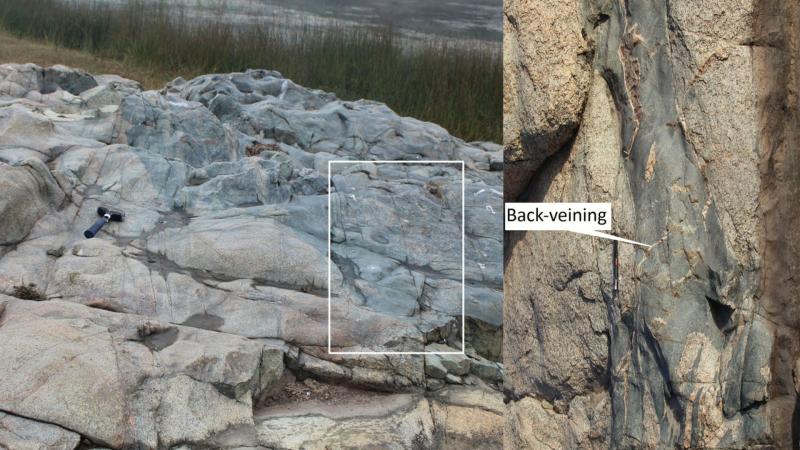
The team embarked on a 65-kilometre journey across the rugged terrain of the Berach River section in Rajasthan. They were hunting for synplutonic dykes, long veins of dark rock that look like scars running through the lighter granite. These dykes act as frozen snapshots of ancient volcanic activity. Along with these veins, the researchers identified microgranular enclaves, which are blobs of one type of rock trapped inside another, much like the droplets in a lava lamp.
They then used Back-Scattered Electron (BSE) microscopy, which uses high-energy electrons to map the surface composition of materials. The method allowed the researchers to zoom in on individual crystals and identify xenocrysts, crystals that were physically ripped from one magma and tossed into another. They found microscopic features indicating that the crystals underwent sudden changes in temperature and chemistry as the two magmas interacted. The study even found back-veining, where the host granite was so hot it actually melted its way back into the dark magma dykes.
By mapping these microscopic features, the researchers were able to reconstruct a story of extreme heat and chemical chaos that occurred miles underground while the Earth was still relatively young. The study also proposes a detailed schematic model which explains the specific stages of how the magma was disrupted, cooled, and eventually frozen into its current state.
While older theories might have simply treated these rocks as a single cooling mass, this study shows that they were part of a recharged system in which fresh pulses of heat from deep within the Earth kept the magma chambers alive and active for much longer than previously thought. This level of microscopic detail allows geologists to see the disequilibrium or the chemical struggle that occurs when the mantle and the crust collide.
However, the researchers also pointed out the limitations of what we can see today. Because the two types of magma have such different physical properties, they often resist complete mixing. This means the final rock is a patchwork of different mini-environments, and while we can see the results of the mixing, the exact journey of the deepest magma from the mantle remains partially shrouded in mystery. Some of the original clues have likely been erased by the billions of years of cooling and geological pressure that followed.
Nonetheless, the study helps us understand the Earth's cooling history, providing essential context for the tectonic forces that build mountains and valleys in the modern world. By reading the microscopic records of the Berach granitoids, we are essentially looking back at the foundation of the Indian subcontinent and learning how the Earth built its first permanent homes.
This article was written with the help of generative AI and edited by an editor at Research Matters.