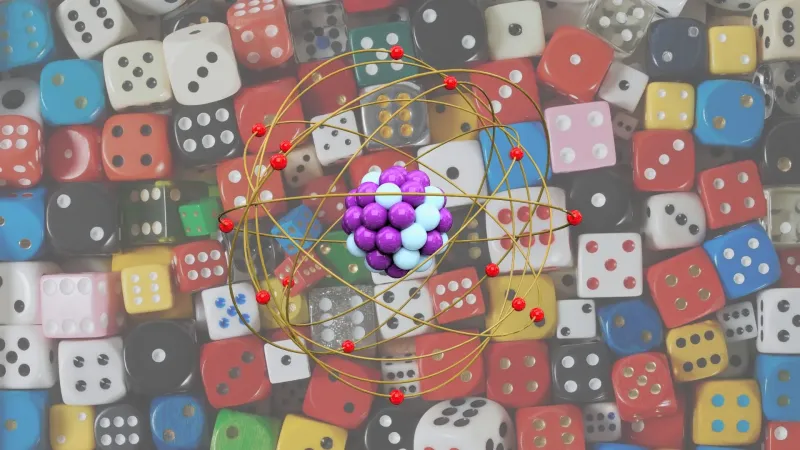
In a breakthrough that promises to bolster online security, from online banking to classified communications, researchers have developed a new type of quantum random number generator (QRNG). The new method is both faster and more trustworthy than its predecessors. The research details a novel device-independent QRNG (DI-QRNG) that achieves megabit-rate speeds while simultaneously certifying its own randomness through a live quantum test, all thanks to a streamlined, beam-splitter-free design.
Random numbers are the unsung heroes of the digital world, forming the backbone of cryptographic protocols and secure communication. Their primary use is generating cryptographic keys, providing the unpredictability that makes encrypted data uncrackable. However, the random numbers generated by classical computer algorithms, known as pseudo-random number generators (PRNGs), are fundamentally deterministic, meaning once an attacker knows the source of the randomness, cracking the key becomes easier, making them vulnerable to prediction and external tampering. Quantum random number generators (QRNGs) offer a high degree of randomness by exploiting the inherent unpredictability of quantum physics.
Did You Know? The Einstein–Podolsky–Rosen (EPR) paradox is a thought experiment proposed by physicists Albert Einstein, Boris Podolsky, and Nathan Rosen, which holds that entanglement is impossible and argues that the description of physical reality provided by quantum mechanics is incomplete. |
The gold standard for security in this field is the Device-Independent QRNG (DI-QRNG). These systems certify their randomness not by trusting the device's internal workings, but by observing the violation of Bell's inequality. Named after John Stewart Bell, the Bell's inequality theorem demonstrates that quantum mechanics is incompatible with classical theories, which assume particles have definite properties before measurement. For their study, the team used the Clauser-Horne-Shimony-Holt (CHSH) form of Bell's inequality to calculate a Bell parameter. If the Bell parameter is greater than 2, the randomness is certified as genuinely quantum.
The problem, historically, has been speed. The complex technical challenges of implementing these quantumness tests have typically led to frustratingly low bit rates, making DI-QRNGs impractical for high-speed applications. The new study from Physical Research Laboratory, Ahmedabad, Indian Institute of Technology (IIT) Gandhinagar, ICFO-Institut de Ciencies Fotoniques, Spain, and Institucio Catalana de Recercai Estudis Avancats (ICREA), Spain, smashes this speed barrier. The team successfully generated 90 million raw random bits in just 46.4 seconds, and after rigorous post-processing, the system achieved a certified bit rate of 1.8 Mbps. Crucially, this post-processed rate is two orders of magnitude higher than previously reported DI-QRNG systems that also feature live Bell test certification.
The innovation lies in the device’s architecture. Most QRNGs rely on physical devices like beam-splitters, which, as the name suggests, split a beam of light into two. Beam splitters are technologically challenging to make perfectly lossless and unbiased. The new design eliminates this requirement. The system uses a single laser and a Sagnac interferometer to generate entangled photon pairs via spontaneous parametric down-conversion (SPDC). Entangled photons or particles are two particles that can influence the behaviour and properties of the other, no matter how far apart they are. These entangled photons are distributed in an annular ring.
The key to the high-speed, self-certifying nature of the device is how the scientists divided this annular ring. They split the ring into six diametrically opposite sections, effectively creating three robust, independent entangled photon sources from a single set of resources. The pair of photons from two of these sources is used to generate the raw random bits. The third pair of entangled photons is used to enforce the system's trustworthiness. This third source is used simultaneously to measure the Bell parameter in real time, providing live quantumness certification without compromising the random bits generated.
The quality of the generated numbers was exceptionally high. The raw bits exhibited a minimum entropy extraction ratio exceeding 97%, meaning nearly all the generated bits were truly random. After post-processing, the final random bit sequences passed all the stringent statistical tests required by the NIST 800-22 and TestU01 suites, confirming their high quality and randomness.
While the results set a new benchmark for high-speed, certified quantum randomness, the researchers acknowledge that the current experimental setup, while demonstrating the principle, was not able to achieve a fully loophole-free Bell measurement. This is primarily due to the relatively low detection efficiency of the single-photon detectors used and the modest physical separation (just over 1 meter) between the measurement devices. Low detection efficiency can act as a potential side classical channel, which prevents the closure of all loopholes required for the most rigorous Bell certification. Furthermore, while the scheme is scalable—meaning the annular ring could be divided into even more sections to boost the bit rate further—doing so would require a proportional increase in the number of detectors, significantly adding to the complexity and cost of the setup.
Despite these constraints, the novel design simplifies the technical requirements for DI-QRNGs and sets a new standard for the trustworthiness of generated random numbers. By providing a high-bit-rate, device-independent QRNG system with live certification, this work offers a critical component for future quantum networks, ultra-secure communication protocols, and advanced cryptographic applications. The ability to generate truly random numbers at practical speeds, certified by the laws of physics themselves, is essential for maintaining security in an increasingly complex digital world.
This article was written with the help of generative AI and edited by an editor at Research Matters.