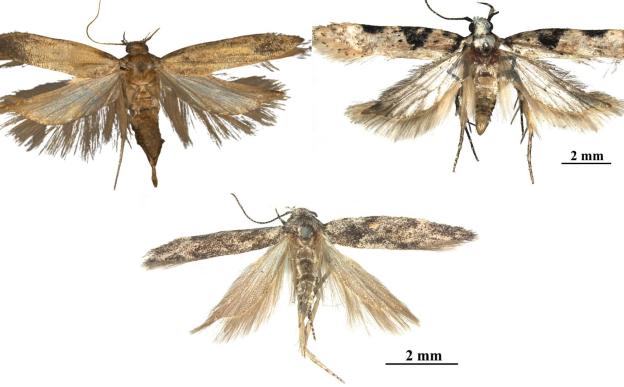
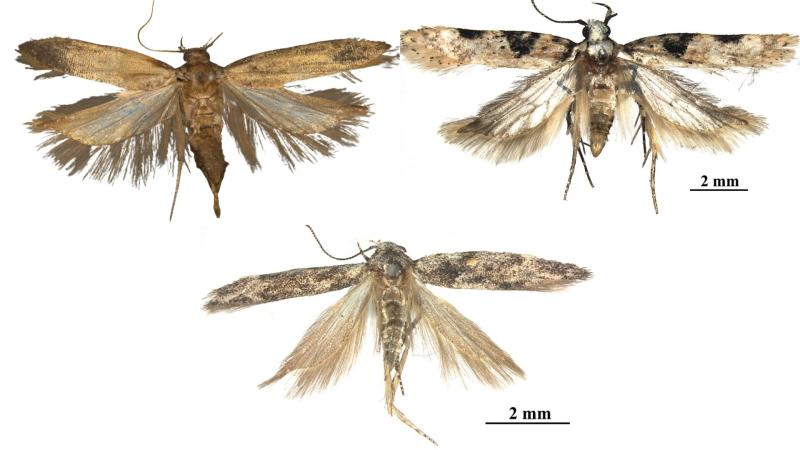
Gelechia bilobuncusa (top, left: ), Gelechia adi (top, right), and Istrianis ladakhensis (bottom). Image credit: Authors, https://doi.org/10.11646/zootaxa.5728.1.6
Researchers have identified three previously unknown species of moths that had remained hidden in the high-altitude landscapes of the Himalayas. Researchers from the ICAR-Indian Agricultural Research Institute in New Delhi confirmed the discovery, following an extensive survey of the insect life in Arunachal Pradesh, Himachal Pradesh, and the Union Territory of Ladakh. The findings highlight the immense and often undocumented biological wealth contained within India's northern mountain ranges.
The discovery was made using mercury-vapour lamps set up at night to attract nocturnal insects, a standard but effective technique for sampling moth populations. Once collected, the specimens underwent a rigorous examination process. The researchers utilised a combination of DNA barcoding and detailed morphological analysis, studying the physical structure of the wings and reproductive organs under high-powered microscopes, to prove that these moths were distinct from any species previously recorded in scientific catalogues. The study contributes to a better understanding of the Gelechiidae family, a massive and diverse group of micro-moths that play various roles in their ecosystems.
The three new species have been named to reflect their locations, local culture, and physical biology. Gelechia adi, discovered in the Ramsing area of Arunachal Pradesh, is named in honour of the local Adi tribe inhabiting the Upper Siang district. It is visually distinct, featuring ivory-white forewings interrupted by a dramatic black streak across the base and triangular spots.
The second species, Gelechia bilobuncusa, was found in Himachal Pradesh. Its name is a scientific nod to the unique bilobed shape of its uncus, a part of the male genitalia. It is characterised by pale brown wings with irregularly scattered black scales. The third species, Istrianis ladakhensis, is named after its type locality in Ladakh. This moth is adapted to the high-altitude environment, sporting light brown wings mottled with dark grey, white, and orange scales, distinguishing it from its closest relatives in the genus.
This research underscores the importance of continuous taxonomic study in India, a country already known to host over 13,000 species of butterflies and moths. While the genus Gelechia and Istrianis have members worldwide, these specific moths are unique to the Indian subcontinent. The researchers have deposited the type specimens, the physical examples used to describe the species, at the National Pusa Collection in New Delhi, ensuring that these tiny new members of the animal kingdom are preserved for future generations of scientists to study.
This article was written with the help of generative AI and edited by an editor at Research Matters.