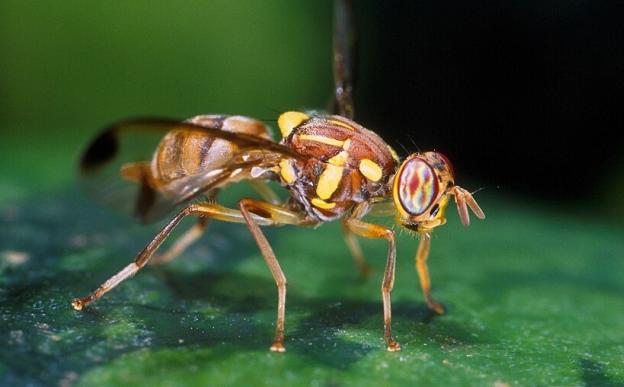
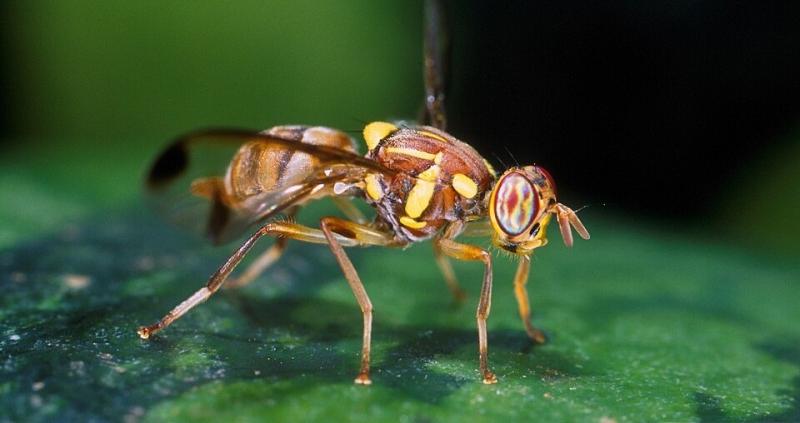
The melon fly, Zeugodacus cucurbitae, is an economically devastating invasive pest capable of destroying a vegetable crop if left unchecked. Native to India but now a global traveller, this fly targets over 81 different host plants, primarily cucurbitaceous vegetables like cucumbers and gourds. The primary challenge for farmers and quarantine officials is not just the adult fly, but its invisible larvae and pupae, which are often hidden inside traded fruits. Identifying these immature stages using traditional methods is a slow, tedious process prone to human error.
Did You Know? Under the right conditions, a single population of melon flies can cause a total (100%) loss of a farmer's crop if they aren't detected in time. |
To bridge this gap, a research team from the ICAR-Indian Agricultural Research Institute developed a novel diagnostic tool, the Melon fly-LAMP assay, for rapid, on-site use without the need for a fully equipped laboratory. The researchers used a technique known as Loop-Mediated Isothermal Amplification, or LAMP. While traditional DNA testing, such as PCR, requires expensive thermal cyclers to cycle through multiple temperature stages, LAMP operates at a single, constant temperature, in this case, 60 degrees Celsius.
Their research targeted the Cytochrome c Oxidase Subunit I (COI) gene, a biological marker for the species. By designing a specific set of primers that recognise multiple regions of this gene, the team ensured that the assay would only trigger a reaction if the melon fly’s DNA was present. The tool also provides a clear visual output: if the target DNA is detected, the reaction fluid changes colour from pink to yellow within 40 minutes. This allows an inspector or farmer to visually confirm the presence of the pest, with little intrusion and at a rapid pace.
To make the system truly field-compatible, the researchers moved away from complex DNA extraction kits. They discovered that simply crushing a small piece of the insect, such as a leg or a single egg, in double-distilled water and briefly heating it was sufficient to release enough DNA for the test. This crude extract method was validated across all life stages of the fly, from egg to adult, and was tested in real-world environments like agricultural fields and bustling vegetable markets in New Delhi. The researchers even conducted blind tests with non-experts to prove that the system was user-friendly and reliable for those without scientific training.
Earlier attempts to develop a detector for this species often suffered from cross-reactivity, leading to false-positive results for closely related species. For instance, previous studies were unable to distinguish the melon fly from Bactrocera latifrons. This new assay, however, was tested against five closely related non-target species and showed 100% specificity. Furthermore, the sensitivity is remarkably high, capable of detecting genomic DNA at concentrations as low as 1 x 10⁻¹² ng/µl. The researchers also caution that the assay is so sensitive that there is a risk of false positives if samples are contaminated with trace amounts of melon fly DNA from previous tests. Therefore, the study emphasises that mixed samples must be handled with extreme caution in the field.
By allowing for immediate identification at shipping ports and quarantine stations, the Melon fly-LAMP assay helps prevent the accidental introduction of pests into new regions. This not only protects the livelihoods of farmers and ensures food security, but also reduces the need for broad-spectrum chemical pesticides by enabling more targeted, timely pest management interventions.
This article was written with the help of generative AI and edited by an editor at Research Matters.