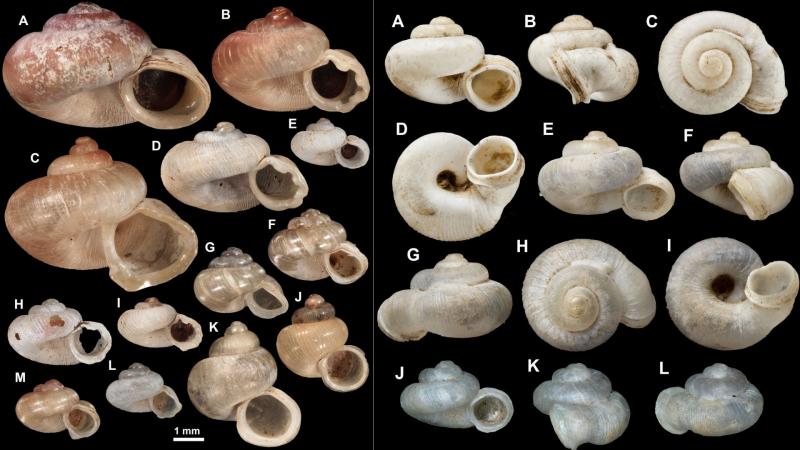
A team of international researchers has discovered seven species of land snails previously unknown to science during an expedition to the 'Blue Mountain' of Mizoram, a remote region in northeastern India. The study, published in the European Journal of Taxonomy, was led by Hungary’s HUN-REN Centre for Agricultural Research, alongside colleagues from the University of Belgrade, Serbia, and Ashoka Trust for Research in Ecology and the Environment (ATREE) in Bengaluru. The discovery is part of a massive scientific effort to catalogue the biodiversity of the Himalayas and Myanmar, an area where many species have remained hidden or misclassified for over a century.
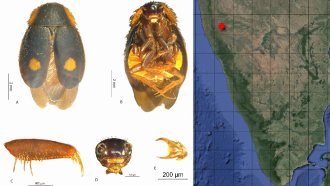
The new species belongs to a group called Alycaeinae, tiny snails famous for a unique biological feature: a sutural tube or breathing pipe. This structure, which looks like a small snorkel attached to the shell, is connected to microscopic tunnels that allow the snail to breathe oxygen even when it has pulled itself deep inside its shell and sealed the entrance. These snails were found on Phawngpui, also known as the Blue Mountain, Mizoram's highest peak. The area is a biodiversity hotspot, but until this study, there were no official records of this snail species ever living in the state.
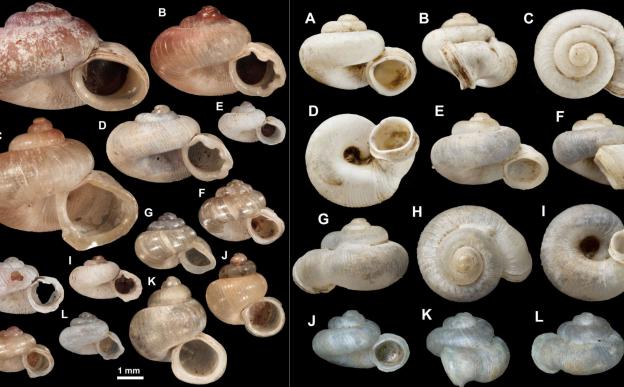
The researchers discovered the snails through a combination of field exploration and historical detective work. After collecting fresh specimens from the mountain’s moist forests, the team had to compare them with thousands of shells stored in European and Indian museums, some collected as far back as the mid-1800s. By using digital microscopes to examine the patterns and ribbing on the shells, the researchers found that seven of the 13 species found on the mountain did not match any known records.
Each of the new species possesses distinct physical traits that set them apart. For example, Chamalycaeus mizoramensis, named after the state of Mizoram, is notably large for its group and features a fringed mouth, or aperture, that looks like delicate lace. Another find, Dicharax praeda, earned its name from the Latin word for prey because it features a specific dent on its shell that resembles a tiny bite mark. The team also honored human contributors through their naming; Cycloryx rohiniae was named after Rohini Nilekani, a prominent Indian philanthropist, recognising its smooth, greenish-yellow shell as a distinct new branch of the snail family tree.
Beyond the discovery of new life, the report serves as a major update to the scientific address book for snails. The researchers conducted a massive cleanup of historical records, identifying 37 cases in which 19th-century scientists accidentally named the same snail species multiple times. By comparing the original type specimens from the 1800s with their new finds, the team consolidated the records, recognising 109 valid species in total. This work is critical for conservation, as scientists cannot protect an animal if they do not know exactly what it is or where it truly lives. The study suggests that many more species may still be waiting to be found in the dense, unexplored forests of the Indo-Burma border.
A complete list of all the new species that were discovered:
- Chamalycaeus mizoramensis: Named after the state of Mizoram. It is a relatively large snail distinguished by its fringed aperture (the opening of the shell) and a specific pattern of fine ribs.
- Chamalycaeus reflectus: The name comes from the Latin word for reflected, referring to its unique outer rim (peristome) that is strongly turned backwards.
- Cycloryx rohiniae: Named in honour of Rohini Nilekani, this snail is characterised by its smooth shell and its lack of ribs on the final section of its body.
- Dicharax praeda: The name praeda is Latin for prey. Scientists chose this name because the snail has a distinct dent on its shell that looks like a tiny bite mark from a predator.
- Dicharax semivivus: Named from the Latin for half-alive. The scientist who found the shell noted it was heavily corroded (looking dead), but because the trapdoor (operculum) was still inside, they knew it had been alive recently.
- Dicharax umashaankeri: Named after Prof. R. Uma Shaanker, a founder of the Ashoka Trust for Research in Ecology and the Environment (ATREE), for his contributions to Indian conservation.
- Dicharax ganeshaiahi: Named after Prof. K.N. Ganeshaiah, also a founder of ATREE and a famous scientist and author who has worked extensively to document India's plants and animals.