News

New Delhi

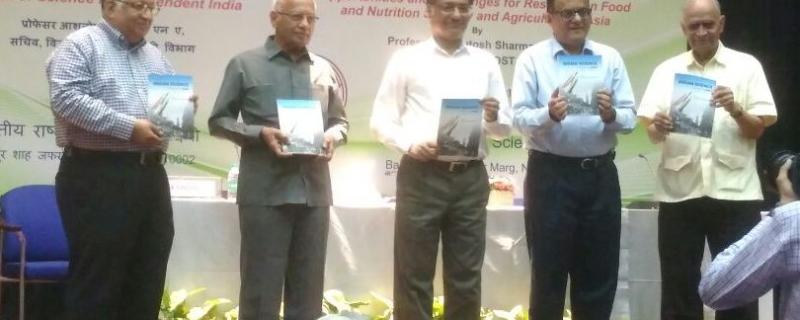
In a ceremony held on the 25th of April, 2018, in New Delhi, the Indian National Science Academy (INSA) has released a new book entitled "Indian Science: Transforming India. Impact of Science in Independent India". The book is a compilation of interesting stories about some of the significant developments in the field of science and technology in the country, and their remarkable impact on the society.
Kharagpur

In the past century, fossil fuels like petrol and diesel have powered our vehicles, machines and in fact, our world! But the era of these fuels is coming to an end; all our petroleum reserves are soon ending, and the increasing pollution due to these fuels is making the world sick. Now, our hope lies in biofuels—fuels produced by organic wastes that are renewable and eco-friendly, unlike fossil fuels.

Dhanbad

Scientist from Indian Institute of Technology (India School of Mines), Dhanbad, Jharkhand are studying the potential environmental risks and hazards of coal ash, by studying the composition of the by product.

Bengaluru

In a step that could ease some tension about India's Neutrino Observatory, the Indian National Science Academy (INSA), the National Academy of Sciences (NAS) and Indian Academy of Sciences (IAS) have issued a joint statement supporting the India-based neutrino observatory to be set up in Bodi West Hills in Theni district of Tamil Nadu.

Bengaluru

A new study by scientists from Indian Institute of Science (IISc) has shown that hues of different colours generate large gamma oscillation in the primary visual cortex, the region of the brain that processes visual information. Reddish hues were seen to cause the strongest oscillations.

Mumbai

Researchers from ICMR-National Institute for Research in Reproductive Health, Bombay, College of Pharmacy, and Indian Institute of Technology Bombay in Mumbai used popular online algorithms and molecular dynamics, to design an effective antimicrobial peptide.

Bengaluru

A team of scientists from Rice University, Texas, USA, Indian Institute of Science (IISc), Bengaluru, Bruker Nano Surfaces, Minnesota, USA and Indian Institute of Technology Gandhinagar, Gujarat have developed a new way to exfoliate a 2 dimensional metal sheet, few layers o even up to a single layer of atoms thick. The novel method, the scientists claim, could be used to make metal sheets of low-melting pure metals and alloys.

Pune

The summer is here, and the newspapers are already flashing headlines on how hot this summer could be. While we humans may turn on the air coolers, what would the thousands of animals and plants do? It turns out, some trees have unique tricks up their leaves, quite literally! A new study by researchers from the Indian Institute of Science Education and Research (IISER), Pune, and Oak Ridge National Laboratory, USA, shows how tropical trees deal with the heat and the adaptations in their leaves that help them survive in extreme heat conditions.

Indore

Scientists at Indian Institute of Technology Indore, Indore have developed L-lyso—a novel water soluble, fluorescent dye which can permeate the membranes of lysosomes, marking them for future tracking and imaging.

Search Research Matters