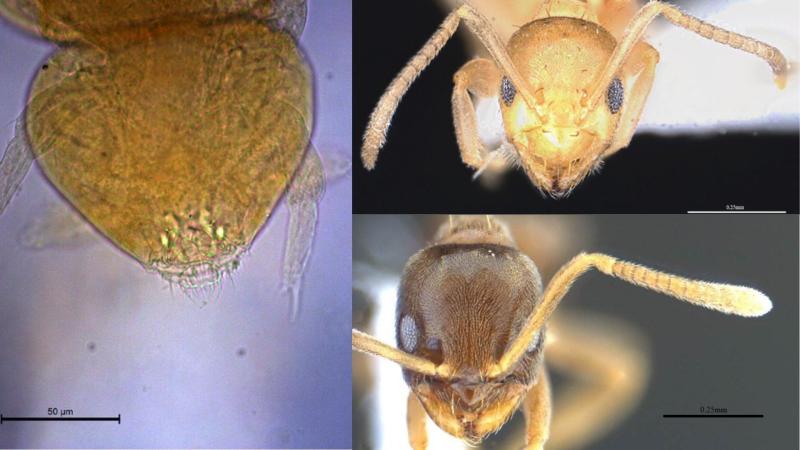
Image: Neelus sikkimensis (Left), and Paraparatrechina ali (Right, top), Paraparatrechina sohryngkham (Right, Bottom), Credits: Authors, https://doi.org/10.51963/jers.v27i3.2902 & https://doi.org/10.51963/jers.v27i3.2956
Researchers from the Zoological Survey of India (ZSI) have discovered three previously unknown species hiding in the soil of the Eastern Himalayas. The discoveries include a microscopic springtail found near a hot spring in Sikkim and two unique ant species living in the tea gardens of Assam and Meghalaya. These findings once again highlight the rich, often-overlooked ecosystem beneath our feet.
The first discovery is from the steam-filled landscapes of North Sikkim. Researchers have identified a new species of Collembola, tiny, wingless creatures often called springtails because of their ability to jump using a tail-like appendage. Named Neelus sikkimensis after Sikkim, the region where it was found, the discovery marks the first report of the genus Neelus in India.
The discovery was made 4 kilometres from the Turum Hot Spring. The researchers collected moss samples with a shovel and processed them using a Tullgren funnel, a device that uses heat and light to gently drive the tiny creatures out of the sample and into a collection tube. Under a microscope, Neelus sikkimensis revealed itself to be incredibly small, measuring just 0.3 to 0.5 millimetres. Despite its size, it is distinct from its cousins in Mexico and Europe due to the unique arrangement of chaetae (bristles) on its mouthparts. Specifically, the new species possesses a serrated or saw-like hair on its upper lip and a distinctively curved bristle, which sets it apart from all other known species worldwide.
Meanwhile, in the lush tea gardens of Northeast India, a separate team of ZSI researchers discovered two new ant species. These ants, named Paraparatrechina sohryngkham and Paraparatrechina ali, were found through careful handpicking from soil litter. P. sohryngkham was discovered in the East Khasi Hills of Meghalaya, while P. ali was found in a tea estate in Jorhat, Assam.
What makes these ants unique is a pinnate setae, or feather-like hairs, never before seen in their genus. While ordinary ants have straight hairs, these new species boast bristles that branch out like feathers. This unique morphological trait has never been documented in the Paraparatrechina genus until now.
Beyond their feathery hairs, the ants have evolved fascinating textures on their bodies. Using Scanning Electron Microscopes (SEM), the team observed that P. ali, which is bright yellow and shiny, features a cluster of flat, hexagonal patterns with round pores near its tail end. P. sohryngkham, which is light brown and opaque, displays a similar hexagonal pattern, but its markings are deeper and more closely packed. P. ali has been named in honor of the late Dr. Musthak Ali, a pioneer in Indian ant taxonomy, while P. sohryngkham bears the name of Sohryngkham village in Meghalaya, the locality where it was found.
These discoveries underscore the biological richness of the Himalayan region. By utilising both traditional field methods like handpicking and microscopic imaging, the Zoological Survey of India continues to reveal that even the smallest organisms, from moss-dwelling springtails to feather-haired ants, play a distinct and complex role in our ecosystem.
This article was written with the help of generative AI and edited by an editor at Research Matters.