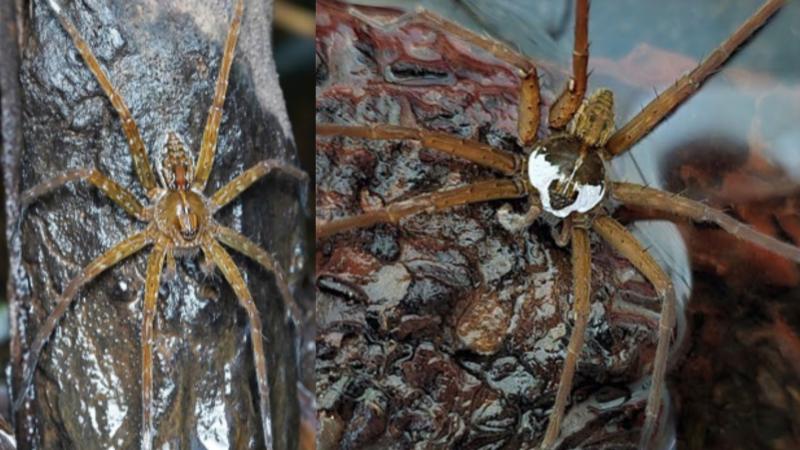
Image: Dolomedes indicus, Adult Female (left) and adult male (right). Credit: Authors https://doi.org/10.1038/s41598-025-26308-2
In the evergreen rainforests of the Western Ghats, researchers have identified a new species of spider that hunts on water rather than spinning webs. The discovery of Dolomedes indicus in the Wayanad district of Kerala marks the first time a spider of the Dolomedes genus, commonly known as raft or fishing spiders, has been described in India. The research was conducted by the Kerala Forest Research Institute, which located the elusive arachnids in the forest areas of Lakkidi and Periya in Wayanad district in Kerala.
Unlike the common house spiders that wait passively in webs, Dolomedes indicus is an active, semi-aquatic predator that uses the water’s surface tension to its advantage. These spiders rest their legs on the water to detect the tiny vibrations from struggling insects or small fish, then launch themselves across the surface to capture prey with lightning speed. They are also capable swimmers and divers. During the study, researchers observed one female submerge herself underwater for nearly an hour and a half to evade detection, breathing through air trapped against her body by specialised hydrophobic hairs.
To confirm that this was indeed a new species, the researchers conducted traditional physical examinations and DNA analysis. While there have been unverified reports of fishing spiders in India, this study provides the first genetic and morphological evidence. The new species is distinguished by specific physical traits, particularly in males, which sport a striking snow-white marking running from their faces down to the centre of their backs. Females are larger and greenish-brown, allowing them to blend perfectly with the mossy rocks and foliage along the stream banks.
The researchers chose the scientific name Dolomedes indicus to mark a significant milestone in the country's natural history, as it represents the first time a species from this genus and family has been described exclusively from India. To ensure that this discovery remains available for future scientific study and verification, the individuals have been permanently preserved and deposited in the Insect Collection of the Kerala Forest Research Institute (KFRI).
The discovery highlights the rich and often unexplored biodiversity of the Western Ghats, a global biodiversity hotspot. The researchers emphasised that Dolomedes indicus appears to be highly sensitive to its environment, thriving only in pristine, cool waters under a forest canopy. Because they are not found in stagnant or polluted water, these spiders could serve as vital indicator species, helping conservationists monitor the health of freshwater ecosystems. As climate change and land use threaten these fragile habitats, the formal identification of this aquatic hunter underscores the urgent need to protect the freshwater streams of southern India.
This article was written with the help of generative AI and edited by an editor at Research Matters.