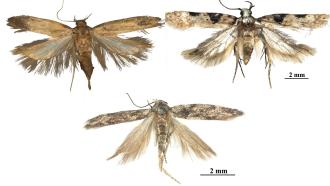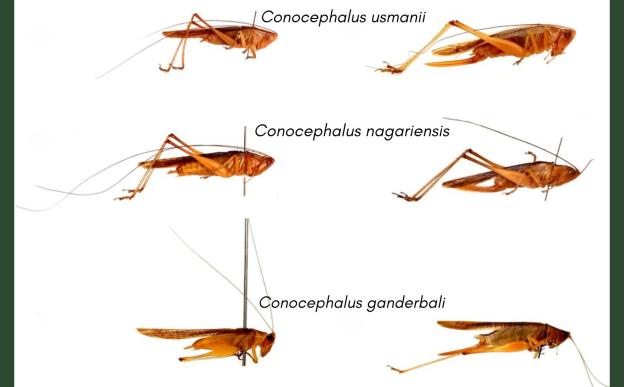
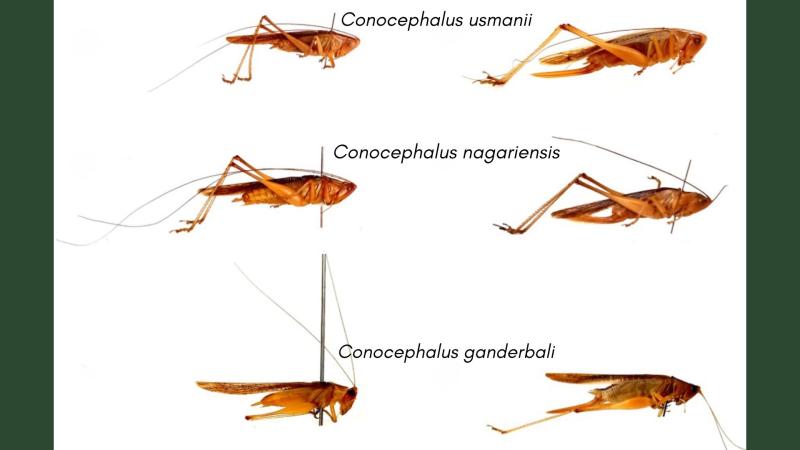
During extensive field surveys across the Jammu and Kashmir region, researchers identified three previously unknown species of the genus Conocephalus, more commonly known as meadow katydids or long-horned grasshoppers. The discovery was led by Muzamil Syed Shah and a team of entomologists from Aligarh Muslim University. The new species have been named Conocephalus usmanii, Conocephalus nagariensis, and Conocephalus ganderbali.
Prior to this study, the mountainous region of Kashmir was thought to host only a single species of this genus. The team’s findings suggest that the area's complex topography, which includes the Western Himalayas and the Pir Panjal Range, has fostered a much richer variety of insect life than previously recorded. To find these elusive insects, the researchers trekked through various habitats, including tall meadow grasses, bushes, and deciduous forests, collecting adult specimens during the day.
The researchers used Scanning Electron Microscopy (SEM) to distinguish the new species from their known relatives. This allowed them to capture high-resolution images of the stridulatory files, a microscopic row of teeth on the male insect's wings that acts like a musical comb to produce their characteristic chirping sound. By counting these teeth and measuring the shape of the insects’ body parts, the team was able to prove they had found entirely new branches of the tree of life.
Each of the three new species possesses unique physical blueprints that set them apart. Conocephalus nagariensis, found in the Budgam district, is distinguished by its spindle-shaped appendages (cerci) and a stridulatory file containing exactly 34 teeth. It is dedicated to Dr. Rajendra Nagar, a researcher credited with discovering several other species of katydids across the country, and bears his name.
In contrast, Conocephalus ganderbali, discovered in the Ganderbal region, is notably small and slender, with a musical file of only 28 teeth and a unique V-shaped incision on its underbelly. Its name is derived from the Ganderbal district in Kashmir, the specific locality where the researchers first collected the specimens.
The third species, Conocephalus usmanii, features a flat, elongated plate on its abdomen and a musical file with 36 teeth. It was named in honour of Professor Mohd Kamil Usmani, a scholar who has made significant contributions to the study of Orthoptera (the group of insects including grasshoppers and katydids) in India.
Beyond the three new species, the study also provided new records for other katydids in the region, such as Conocephalus longipennis and C. kwasiphaiensis, which were previously known only in other parts of India. This suggests that Kashmir serves as a vital corridor for insect migration and evolution.
The discovery highlights how much of the natural world remains unexplored, even in well-known geographical areas. The researchers noted that because Kashmir is so biologically diverse yet understudied, many more species likely remain hidden in plain sight within its mountain valleys. The physical type specimens used to describe these new insects have been deposited in the Museum of Zoology at Aligarh Muslim University, where they will serve as a permanent reference for future generations of scientists.
This article was written with the help of generative AI and edited by an editor at Research Matters.