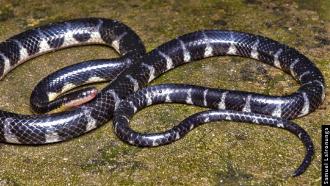
A new study by researchers from the Indian Institute of Science (IISc) has shown that the amount of venom produced by the big four snakes is overwhelmingly determined by the snake's life stage (age) rather than its sex or geographic location. The finding could have immediate implications for improving antivenom production and clinical treatment across the subcontinent.
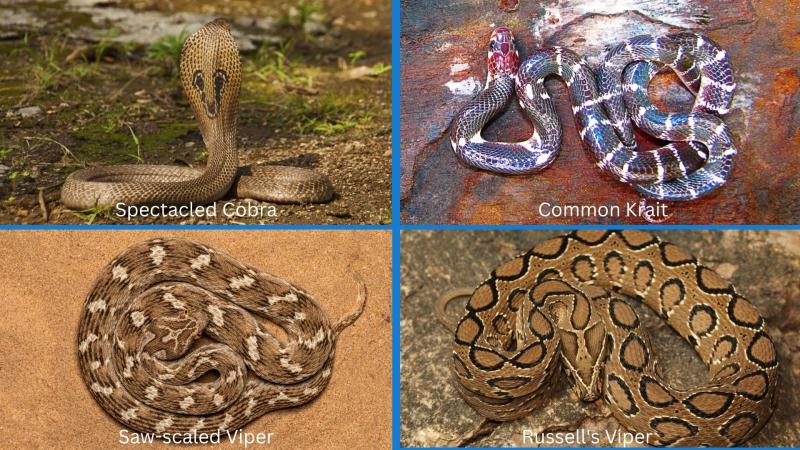
Snakebites continue to be a significant threat across India, with around 5 million snakebites occurring each year, according to the World Health Organisation. It has led to around 1,38,000 deaths and up to 4,00,000 disabilities each year. The big four species—the spectacled cobra, Russell's viper, common krait, and saw-scaled viper—are responsible for the vast majority of serious envenomations.
Did You Know? The "Big Four" are not the only dangerous snakes of India: While the four species are responsible for the most bites, India is home to over 350 snake species, nearly 60 of which are considered clinically relevant to humans. |
To understand how much venom each snake delivers per bite, the researchers collected and quantified venom from the big four snakes across India's major bioclimatic zones. They collected venom samples from 338 wild-caught snakes during rescue operations coordinated with State Forest Departments and local snake rescuers across 10 states in India between 2021 and 2024. The venom was collected by experienced herpetologists using safe handling methods, encouraging the snake to bite onto a sterile parafilm stretched over a beaker. After extraction, all snakes were safely returned to their natural habitats. The collected crude venom was then freeze-dried (lyophilised) and its dry weight measured using a high-precision microbalance. This systematic, pan-Indian approach to sampling wild populations yielded a vast, diverse dataset.
The findings reveal substantial variation in venom output among the species, a pattern that largely correlates with the snake's overall body size. The two larger species, the Spectacled Cobra and the Russell's Viper, were the high-yield producers, meaning they delivered large quantities of venom with every bite. They averaged 136.10 mg and 106.60 mg of dry venom, respectively. In stark contrast, the smaller Common Krait (Bungarus caeruleus) and the Saw-scaled Viper (Echis carinatus) produced significantly less, with average yields of only 8.95 mg and 2.76 mg.
The most significant factor influencing this yield, however, was the snake's developmental stage. The study found statistically significant differences in venom yield across life stages for the cobra, Russell's viper, and saw-scaled viper. For example, adult Spectacled Cobras had a median venom yield of 125.00 mg, which is nearly three times the 47.60 mg median yield of subadults and almost twenty times the 6.50 mg median yield of juveniles. Similar trends were observed in Russell's Viper, with adults producing the highest median yield (95.69 mg) compared to juveniles (3.00 mg). This pattern strongly suggests that as a snake grows and matures, its capacity to produce and deliver venom increases dramatically.
Interestingly, the researchers found that sex-based differences were statistically insignificant across all four species. Male and female cobras, Russell's vipers, kraits, and saw-scaled vipers produced comparable amounts of venom, with their data points showing considerable overlap. Furthermore, geographic location had a minor effect on venom yield for most species. The cobra, Russell's viper, and saw-scaled viper did not show significant differences in venom output across the various biogeographic regions of India, such as the Coast, Deccan Plateau, and Western Ghats. The one exception was the Common Krait, in which individuals from the Gangetic Plains produced substantially higher venom yields than those from the Western Ghats. This variation may reflect ecological adaptations to local prey availability or habitat structure.
The research also points to the distinct envenomation strategies that have evolved in these snakes. The high-yield species, such as the cobra and Russell's viper, employ a strategy of delivering a large volume of moderately toxic venom. Conversely, the Common Krait stands out as a low-yield, high-potency specialist. Despite having one of the lowest average yields (8.95 mg), its venom is exceptionally potent (the most toxic of the four). The Saw-scaled Viper, with the smallest yield and least toxic venom, remains a leading cause of envenomation, underscoring that factors beyond yield and potency, such as bite frequency, also shape the overall snakebite burden.
The study provides the first comprehensive, pan-Indian baseline data on venom yield dynamics. The insights from the findings could inform public health and conservation efforts in India. By providing robust, regionally representative data on venom yields across different life stages, this research can directly guide improvements in antivenom administration. Knowing the typical dose injected by an adult cobra in a specific region also allows manufacturers to formulate more effective immunisation mixtures. It helps clinicians refine dosing algorithms for snakebite victims, ultimately improving treatment outcomes and reducing the substantial mortality and disability caused by snakebite in India today.
This article was written with the help of generative AI and edited by an editor at Research Matters.