Over the course of billions of years of evolution, life has found elegant and efficient ways to overcome many of the challenges posed by the ever-changing environment. As humans began to build the modern world, we found solutions to many challenges by mimicking biological organisms and systems, a phenomenon known as biomimicry. While biomimicry is primarily used to find engineering solutions, it can occasionally produce unexpected results, revealing something far more fundamental about the organisms we mimic and life itself.
In one such case, a team of researchers created a simple, macroscopic robotic system that spontaneously mimics the complex, erratic swimming behaviour of single-celled organisms such as algae. Researchers from the Department of Physics, Indian Institute of Technology (IIT) Bombay and School of Physical Sciences, IIT Mandi designed a pair of coupled robots that, for the first time in an artificial setting, accurately replicated the run-and-tumble (RT) motion exhibited by microswimmers such as the alga Chlamydomonas reinhardtii. Lead authors, Somnath Paramanick (IIT Bombay) and Umashankar Pardhi (IIT Mandi), worked under the guidance of Prof Nitin Kumar (IIT Bombay) and Prof Harsh Soni (IIT Mandi) for this study, which could help us better understand one of the most fundamental aspects of life: motility, or the ability to move. Their study was published in the journal Physical Review Letters.
The run-and-tumble motion is one of the most common navigation patterns observed in microorganisms like bacteria and algae. Such organisms generally swim in a relatively straight line, called the run, before abruptly halting and changing to a new, random direction, referred to as the tumble.
“The single-cell alga, Chlamydomonas, swims by rhythmically beating its two flagella (whip-like structures used for locomotion) attached in front of its body to move forward along a straight path. This is known as the run phase. Occasionally, however, the flagella fall out of phase, leading to asynchronous beating, resulting in a sudden change in direction and leading to a tumble event,” explains Prof Kumar.
To mimic the organism, the researchers built a robotic analogue.
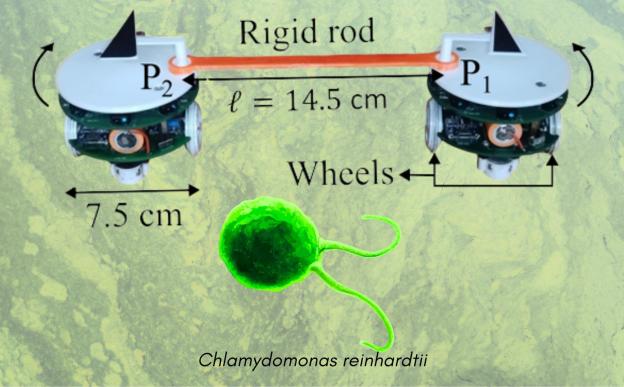
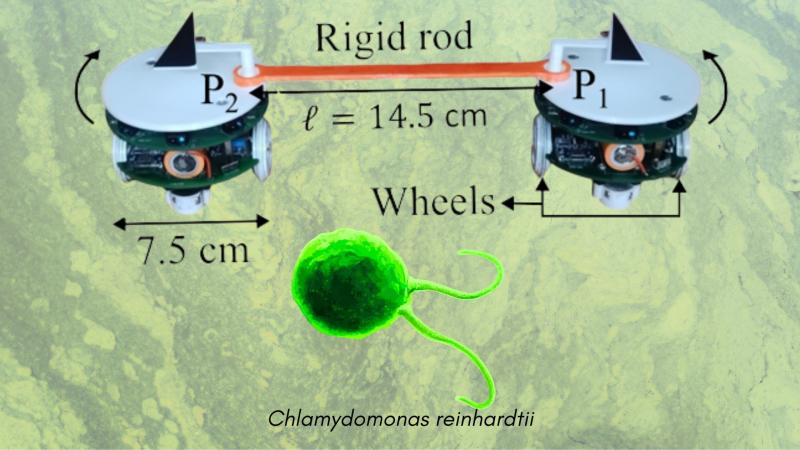
“We replaced the flagella with two self-propelled robots that were mechanically coupled with rigid rods,” explains Prof Kumar.
The researchers' primary focus was on mechanical coupling. In microorganisms, the bases of the two flagella are connected by a tiny internal structure known as a distal fibre. Altering the elasticity and orientation of the fibres provides the organism with the ability to steer and tumble. Past studies have shown that the organism can alter the contractility or stiffness of this fibre in response to environmental cues, like light. The fibre is also believed to alter the orientation of flagella near the anchor points with respect to the body axis, thereby influencing their swimming behaviour.
To replicate the fibre’s role in the RT motion, the team connected the two robots with a rigid rod attached to each robot at mirror-symmetric, off-centred pivot points, mimicking the distal fibre. They varied two key parameters of the connecting rod: the distance from the pivot point to the robot's centre, and the angle between the pivot point and the robot’s orientation axis. These parameters were the model's way of incorporating the effect of the contractile fibre's adjustability.
According to Prof Soni, “By keeping the model minimal, we aimed to capture the essential physical ingredients behind the motion, without relying on complex biological details.”
Another major challenge in studying tiny swimming organisms is recreating the kind of world they live in. Microbes such as bacteria and algae are so small that the water around them behaves differently than it does for us. While water feels light and flows easily at a human scale, for these microscopic swimmers, the same water behaves more like a thick syrup. Because of this, microbes live in a world where friction dominates, and momentum hardly matters. As soon as they stop propelling themselves, they stop moving instantly. To describe and study this kind of motion, scientists often use a simple theoretical model in which movement is driven by constant self-propulsion but is strongly damped by friction. This model, known as overdamped active Brownian (AB) motion, helps capture how microswimmers move in highly viscous environments.
For their study, the researchers recreated this environment by programming their robots to propel themselves forward using wheels. The robots were then placed on a flat, high-friction surface where the wheels could roll without slipping. This arrangement accurately emulated the overdamped AB motion.
“This setup effectively eliminates inertia, allowing our macroscale robots to obey the same physical equations of motion that govern microscopic algae in water,” remarks Prof Kumar.
With the robotic analogues and the correct environment established, the coupled robots were set in motion. To the team’s surprise, they exhibited dynamics remarkably similar to those of the real alga. The system executed long, nearly straight runs interspersed with abrupt, sharp, direction-reversing tumbles.
“Each robot experiences a constant-magnitude active force whose direction fluctuates randomly, with the degree of randomness varied in our experiments. When the two forces happen to align, the pair moves forward along a straight trajectory, reproducing the run phase. At random times, the spontaneous misalignment of forces produces a net torque that reorients the system, generating a direction-reversal event similar to Chlamydomonas's tumble,” says Prof Kumar.
When measured, the robotic system displayed a run time, which is the time for which the robots run straight before they tumble, similar to that of the ubiquitously observed pattern in real microorganisms, including swimming bacteria and algae. Furthermore, the tumbles were found to be very sharp, often resulting in a complete 180-degree direction reversal, similar to observations in Chlamydomonas.
Through their theoretical model, led by Prof Harsh Soni from IIT Mandi, the researchers showed that the run state corresponds to stable, fixed configurations of the coupled robots. The tumble state emerged spontaneously from the interplay between the robots' active self-propulsion forces and their corresponding moments (torque) generated by the connecting rod.
“In fact, our ongoing work shows that the same model can also help explain the spinning motion observed in Chlamydomonas”, remarks Prof Soni.
The tunability of the parameters proved significant, as varying the angle and distance of the connecting rod enabled the researchers to control the tumbling frequency. The tunability also allowed the team to create a phase diagram or graph that governs when stable running breaks down into a tumble. For instance, high values of the angle of connection led to a region of virtually zero tumbling, allowing the robot to run almost indefinitely. This tunability is a direct analogue of how the real organism might adjust its internal fibre to swim through different conditions.
Interestingly, their robotic analogue shows that the surrounding water plays little to no role in the organisms' RT motion. The entire RT motion was recreated by tuning the interaction of the two robots and the connecting rod.
“Our entire experimental framework was built on the conjecture that hydrodynamic interactions are not necessary to generate cycles of synchronous and asynchronous flagellar beating. In our robotic system, this is naturally achieved, since the robots move on a dry, frictional surface where hydrodynamics is absent,” remarks Prof Kumar.
The success of this robot system, which accurately simulates the dynamics and tunability of a real alga, could pave the way for the development of functional, autonomous microscopic machines for healthcare. More importantly, however, the research offers a valuable insight into the underlying physics of motility in the microscopic world.
“This approach provides a way to explore how different swimming modes can emerge from simple physical mechanisms, which may be relevant for a broader class of active matter systems,” remarks Prof Soni.
Talking about how their research could inform fundamental biology,
Prof Kumar says “A key prediction emerging from our results is that, just as tuning the pivot angles allows the robot to vary its tumbling frequency and running speed, Chlamydomonas may regulate the mechanical properties of its distal fibre to transition between synchronous (run) and asynchronous (tumble) beating.”