Radio-images of the Sun explains the anomaly in its atmospheric temperature
A recent study by researchers at National Centre for Radio Astrophysics (NCRA) in Pune, India, explains the anomaly in the sun's atmospheric temperature.
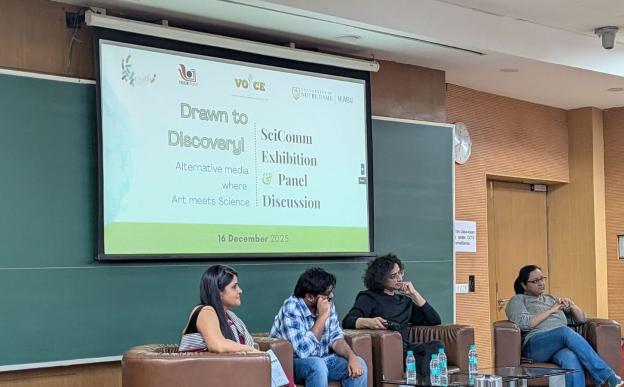
The Indian Institute of Science Education and Research (IISER) Pune on Tuesday launched the VOICE Fellowship 2025
A recent study by researchers at National Centre for Radio Astrophysics (NCRA) in Pune, India, explains the anomaly in the sun's atmospheric temperature.
Researchers develop a powerful stochastic neuron, like those in our brain, using random access memory to aid breakthroughs in artificial intelligence
In a recent study published in Nature Communications, researchers have described a new statistical method, ‘LinTIMaT’, for reconstructing cellular lineages, giving scientists the ability to deduce the evolution of cells in a biologically growing system.
In a recent study, researchers synthesize a novel trehalose molecule that can form long, helical polymers under high temperatures.
In a recent study, researchers have found a new mechanism of controlling protein synthesis in the malaria-causing parasite, Plasmodium.
In nature, colours are everywhere! Insects, birds, and mammals—all of them have vibrant colours and patterns on their bodies, which not only make them look pretty but play a role in behaviour and survival. Some use their kaleidoscopic looks to attract mates and stand out from their background; others prefer a dull look to blend into their surroundings and hide from predators. In some insects, like a few damselflies, males and females are differently coloured. Since the males mostly initiate mating in these insects, this difference in colours helps them to find a mate. A new study has now explored how colours impact the mating behaviour of a species of damselfly, Agriocnemis pygmaea.
In a recent study, researchers have proved that when we talk to our loved ones, the variations in our speech are independent of language and culture. It also shows that a lack of such variety in our talk can result in problems with social communication.
A recent study by a team of researchers gives some insights into diagnosing bladder cancer early enough and preventing misinterpretation.
Researchers use radar data from satellites to estimate parameters that determine the growth of soy and wheat.
Researchers suggest an experiment to understand when and how cloning can happen in nature.