Deep-dive

Bengaluru

According to the National Tiger Estimation survey, the number of tigers has surged to 2967, indicating a doubling of tiger numbers since the first survey conducted in 2006 under a revised monitoring methodology. Although this change may sound exciting to the layperson, some scientists have flagged concerns about accepting these claimed changes in tiger numbers. In a recent study, published in the journal Conservation Science and Practice, researchers from India and Norway refer to important mathematical, statistical and ecological principles and highlight how India’s tiger survey results deviate from these principles.
Bengaluru

As COVID-19 pandemic marches on in India with over 800 positive cases and 19 deaths at the time of this article, there is an urgent need for deploying out-of-the-box innovations that can help curb this menace.


Mumbai

Researchers at the Tata Institute of Fundamental Research, Mumbai have discovered that tiny RNAs, called microRNAs, help our cells to maintain an equilibrium of energy production during states of upheaval—fasting and feasting.

Bengaluru

In 2008, the Indian Space Research Organisation (ISRO) announced Aditya-1, India's first solar mission to study the Sun. This ambitious endeavour, with various indigenously-developed instruments onboard, holds much promise for our scientific community as they expect to unravel the mysteries of our closest star, the Sun. Now renamed as Aditya L1, the data from the instruments onboard are expected to be a treasure-trove of information on the dynamic processes on the Sun's surface and its atmosphere.


Bengaluru

In a recent study, researchers have described how chickpea evades blight infection, thus paving the way to develop a blight-tolerant mustard variety.


Bengaluru

A new study by researchers at the Indian Institute of Science Education and Research (IISER) Kolkata, shows that dogs too have developed strategies to coexist with humans, and numbers play a role in it. 

Bengaluru

Vehicular exhaust is a significant cause of air pollution in India, resulting in the rise of many fatal respiratory illnesses.

Bengaluru

Research shows a regional nuclear conflict could affect global crop yields and food supply

Bengaluru

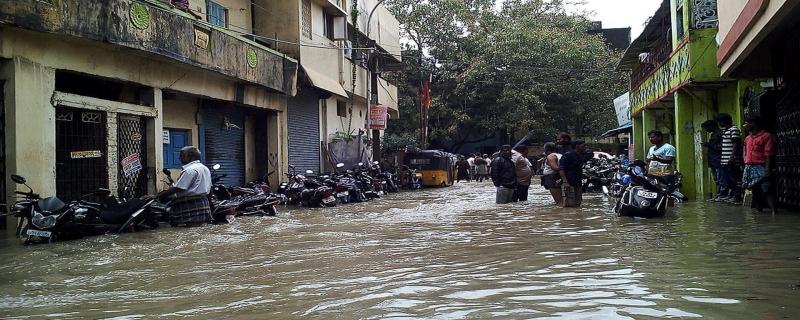
 During the fag end of 2015, Chennai experienced severe floods resulting in the death of about 500 people and economic losses of about INR 50,000 crores. The flooding stranded the city and was termed a 'man-made disaster' resulting from irresponsible water management and rapid urbanisation. The northeast monsoon of the year left most parts of South India marooned, exposing how vulnerable our cities are to such catastrophes. That's when the Office of the Principal Scientific Advisor took a major initiative to develop a real-time, integrated, urban flood forecasting system that was non-existent in our country. Soon after, a team of scientists from various institutes across the country, swung into action to develop the first-ever expert system in India to forecast floods. In a recent study, published in the journal Current Science, the researchers shed light on the development of the automated flood forecasting expert system. 

Bengaluru

Nature is an enigma; an ensemble of complex structures and functions come together to form a variety of mesmerising artefacts, including life. Richard Feynman, the well-known American Nobel Laureate and physicist, famously said—"Nature isn't classical, dammit, and if you want to make a simulation of nature, you'd better make it quantum mechanical, and by golly it's a wonderful problem, because it doesn't look so easy".

Search Research Matters