Researchers have developed a versatile organic crystal that can receive and transmit encrypted data from any angle, paving the way for faster, more secure wireless communication.

General

Bengaluru

Rampant sand mining over the decades in India and many parts Asia has led to eroding coastlines and degraded waterways in much of the continent. Christina Larson, a journalist from Kihim, India has looked the severe ecological damage caused by unbridled epidemic of illegal sand mining.

Bengaluru

The forest owlet (Heteroglaux blewitti), an owl endemic to the forests of Central India, has been the centre of a century-old debate among ornithologists. Its classification into the particular genera is at the stem of this debate. Now, a new study by researchers, involving genetic analysis of the owl’s genome, may put an end to this debate forever.

Have you ever received an electric shock while operating everyday electronic devices?  Ever wondered why? One of the most probable reasons could be faulty earthing.

The term earthing is not as intriguing as it sounds, for it does in fact involve a connection to the earth. It is a safety installation, which involves connecting the non-electricity carrying part of an electrical system to the mass of the earth so that any electrical energy that gets built up in this part is discharged to the ground.

Delhi

Tuberculosis(TB) has claimed 1.8 million human lives globally according to World Health Organization, in 2015. Despite Bacillus Calmette-Guerin (BCG) vaccine, the only available vaccine for TB, currently one-third of the world is latently infected with TB due to the incompetence of BCG in adults against Mycobacterium tuberculosis, the bacteria responsible for TB.

Chennai

Researchers from Anna University, Chennai use a microwave-based remote sensing technique to assess changes in Kolkata’s land subsidence for the years 2003, 2007 and 2011. Their resuls indicate that the city might in fact be slowly sinking.

Bengaluru

The 28th of February every year is celebrated across the country as ‘National Science Day’ to commemorate the discovery of ‘Raman effect’ by Sir C V Raman. About 90 years ago, Sir Chandrasekhara Venkata Raman, had a ‘eureka moment’ when he discovered how light scattered when it travelled in a transparent medium. After two years, this discovery won India her first Nobel Prize in Physics, for a work that was carried out entirely in India.

Bengaluru

Dr. Attreyee Ghosh is a solid earth geophysicist at the Indian Institute of Science, Bangalore, talks about the advancements made in science in the recent years and how these have helped us in understanding our planet better.

Mumbai

“Honesty is the best policy - when there is money in it”, quipped Mark Twain.

Though the abilities of computers have increased exponentially, recognising sarcastic commentary such as “being awake at 4am with a headache is fun”, still remains a challenge. Unlike humans, who use visual and physical cues like rolling of eyes to detect sarcasm, computers have to rely only on text. For the past decade, linguistic studies have accelerated enhancements in computational irony.

Are you a fan of detective TV shows? If so, you will know of DNA Fingerprinting as a tool to identify a criminal.

Everyone’s DNA, much like a fingerprint, is unique. Repeating sequences of DNA called tandem repeats are present between genes. The number each repeat sequence varies from person to person. We can generate a unique pattern of tandem repeats for every person using specialized laboratory techniques. Identical twins are an exception to this case since they have the same DNA fingerprint.

Bengaluru

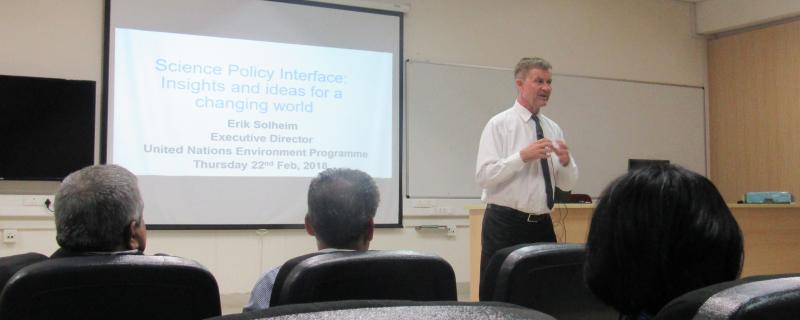
Erik Solenheim, Executive Director of the United Nations Environment Programme visited Center for Ecological Sciences at Indian Institute of Science (IISc), Bengaluru to deliver a talk about the interface of science and policy.

In his talk titled ‘Science Policy Interface: Insights and ideas for a changing world’ Mr. Solenheim spoke about the three main environmental challenges of we face today namely; climate change, pollution and loss of biodiversity.

Search Research Matters