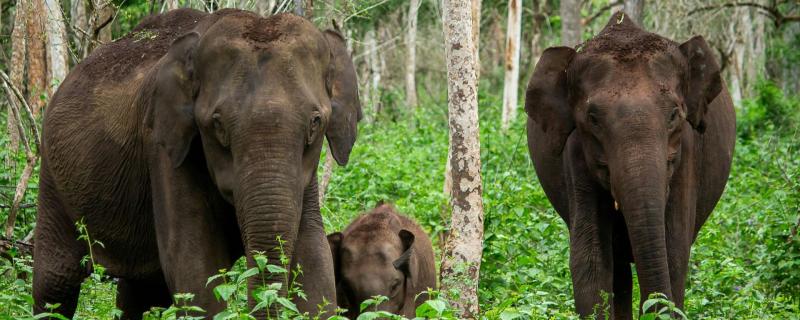
New research from India reveals that, contrary to long-held scientific beliefs, feeding on trees and shrubs does not provide Asian elephants with more protein than grazing on grass.

Archives

New study on India's four most medically important snakes—the spectacled cobra, Russell's viper, common krait, and saw-scaled viper—has revealed that a snake's age, or life stage, is the dominant factor determining the amount of venom it produces.

Researchers used genetic tracking and spatial modelling to overcome the limitations of dung counts, providing a reliable census of Asia's threatened elephants.

A newly observed gravitational wave event from the collision of two massive, rapidly spinning black holes forces scientists to reconsider how these cosmic giants are born and grow.

Synergistic pressures from land use changes and climate extremes are the primary drivers behind a worrying decline in the Western Ghats' ability to absorb carbon.

Pilia, an enigmatic genus of jumping spider has just been rediscovered in the tropical forests of Western Ghats after a staggering 123 years. The find has not only led to the description of a brand-new species, Pilia malenadu, but,  also allowed researchers to document the first-ever female of the entire genus.

Researchers find early warning signs of diabetic kidney disease and pave the way for personalised treatment.

शोधकर्ताओं ने मधुमेहजन्य किडनी रोग के प्रारंभिक चेतावनी संकेतों की खोज की है और व्यक्तिगत उपचार का मार्ग प्रशस्त किया है।

भारतीयांमध्ये मधुमेह-संबंधित मूत्रपिंड विकार प्रारंभिक अवस्थेत ओळखू शकणारे नवीन संशोधन रुग्णाला अनुसरून उपचारपद्धती निश्चित करायला मदत करू शकेल.

Novel scheme by IIT Bombay researchers to control drones can enable complex formation flying using only camera data, without GPS or inter-drone communication.

Search Research Matters