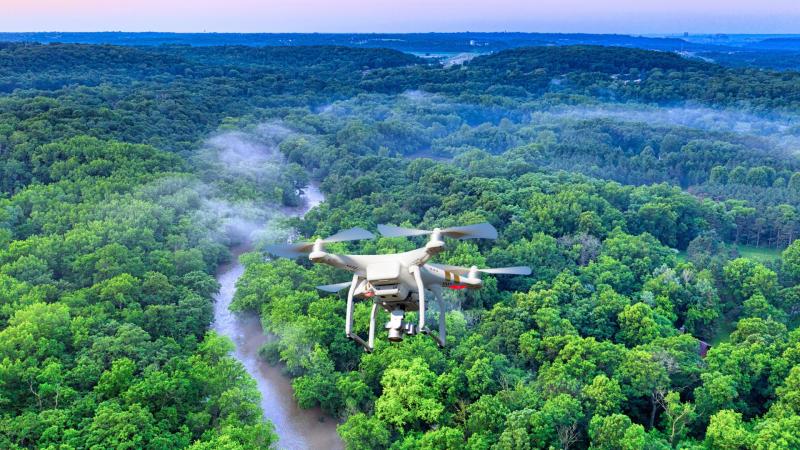
Researchers at the Vellore Institute of Technology in Chennai, India, have developed a new system that uses deep learning and drone imagery to automatically count and classify trees. The new system, dubbed the Aerial Eye Tree Detection Algorithm (AETDA), offers a fast and highly accurate alternative to traditional, time-consuming manual surveys. The work represents a significant leap forward in forest management, providing a practical and scalable solution for informed decision-making in forest land division and resource management projects.
AETDA leverages the deep learning model YOLOv8 (You Only Look Once, version 8) to successfully detect and classify individual tree crowns, specifically banana, oil palm, and coconut trees, from high-resolution aerial photos. This method achieved an overall mean Average Precision (mAP50) of 0.722, with oil palm trees showing the highest accuracy at 0.912, proving its effectiveness in real-world, complex environments. This high-speed, high-accuracy capability is essential for modern sustainable land management, especially as urbanisation and infrastructure projects increasingly require the diversion of forest land.
Did You Know? While satellites can cover huge areas, their images are often blurry, showing a single pixel for every 1 to 5 square meters. Drones can capture images where a single pixel represents less than 10 centimetres, allowing the AI to spot individual tree crowns with incredible precision. |
Traditional tree enumeration methods, which involve manually tagging trees or relying on satellite data, can be labour-intensive, costly, and highly prone to human error, making them inefficient for managing vast or challenging terrains. To overcome this, the researchers turned to drones, which provide high-resolution imagery at sub-10 cm per pixel, offering far finer detail than satellite images, which typically range from 1 to 5 meters per pixel. This detailed aerial data, combined with computer vision algorithms, allows for precise tree detection and categorisation.
The AETDA system works by taking aerial images and converting them into a standardised format. The images, which included banana, oil palm, and coconut trees, were resized to a consistent 512x512 pixel resolution and then annotated with bounding boxes around each tree crown, essentially teaching the model what each tree looks like and where its boundaries are. This rigorous data preparation, including quality checks to eliminate mislabeling, was crucial for training a reliable model.
The researchers then tested and compared four different deep learning architectures to find the best fit for the task: ResNet, VGG16 with a detection head, DEtection TRansformer (DETR), and YOLOv8. The comparison revealed the specific strengths and weaknesses of each model. ResNet, for instance, was found to be excellent for simple image classification but lacked the ability to localise or count multiple trees in a single image, making it unsuitable for the project's multi-instance requirements. The VGG16 model, when modified with a detection head, showed high classification accuracy (98.39% final test accuracy) and provided a more comprehensive coverage of the image, but its bounding box precision was less accurate compared to the final choice . The DETR model, which uses a transformer architecture, demonstrated strong tree counting ability but struggled with precise localisation, often producing overlapping or inconsistent bounding boxes .
Ultimately, YOLOv8 emerged as the best all-around performer. It is optimised for real-time object detection and provides the optimal balance between detection accuracy, localisation precision, and computational efficiency. YOLOv8’s lightweight design and use of techniques like Non-Maximum Suppression (NMS) to eliminate duplicate bounding boxes ensured it met the project's requirements for high precision in both classification and localisation with marginal computational demands .
By successfully integrating high-resolution drone imagery with a highly efficient deep learning model for a comprehensive tree enumeration task, AETDA offers a robust and efficient solution for automated tree detection and classification. It provides government agencies and environmental organisations with a scalable tool to support sustainable leadership practices. By accurately measuring tree quantity and layout, the system enables better planning for more informed zoning policies and the assessment of urban greenery. This integration of technological insights with sustainable practices is vital for managing global ecosystems in the face of growing urbanisation and deforestation.
This article was written with the help of generative AI and edited by an editor at Research Matters.