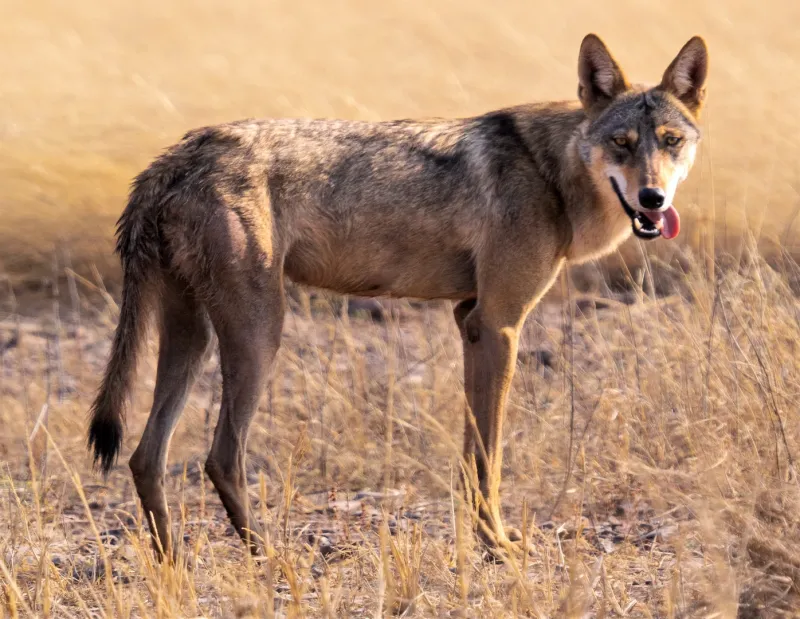
In the scrublands of Karnataka’s Gadag district, a cultural severance is emerging that could determine the future of the endangered Indian wolf. For centuries, the pastoral communities of the Deccan Plateau have lived alongside these apex predators in a relationship defined not by conflict, but by a surprising tolerance rooted in spiritual belief. However, a new study reveals that this ancient truce is fracturing along generational faultlines. While shepherds over the age of 30 continue to view the wolf as a sacred companion that ensures the health of their flocks, the younger generation, burdened by economic pressures and disconnected from traditional lore, increasingly sees the animal as a pest that needs to be controlled.
This discovery comes from a collaborative effort between researchers at Eurac Research in Italy and the Wildlife Institute of India. The team set out to understand how human communities coexist with large carnivores outside of protected nature reserves. In November 2023, the team ventured into the rural territories surrounding the Kappatagudda Wildlife Sanctuary, a biodiversity hotspot in Gadag.
They opted for a socio-ecological approach, conducting in-depth, face-to-face interviews with 42 shepherds across 32 different locations, ranging from the sanctuary's edge to villages 66 kilometres away. By showing the shepherds photographs of wolves, jackals, and hyenas to ensure accurate identification, the researchers were able to document the lived experiences of the shepherds who walk the landscape daily.
The Indian wolf (Canis lupus pallipes) is a distinct subspecies adapted to the semi-arid plains. Unlike its cousins in North America or Europe, it lives almost entirely within human-dominated landscapes rather than deep wilderness. The study found that the survival of these wolves has largely depended on ‘Traditional Ecological Knowledge’, a cumulative body of knowledge, practice, and belief that evolves through adaptive processes.
For the older shepherds, this knowledge manifests in the belief that wolves are agents of the pastoral gods, such as Biroba or Beerappa. These elders described the wolf as a necessary element of their ecosystem. They believe that by preying on sick or weak sheep, the wolves prevent the spread of disease, ultimately making the flock stronger. When a wolf takes a sheep, the older generation of shepherds views it not as a financial loss, but as a tithe or offering to the divine, ensuring future prosperity.
Did you know? The Indian Wolf (Canis lupus pallipes) is a unique subspecies. It is smaller than the Himalayan wolf but larger than the Arabian wolf, and it has adapted to survive in hot, scrubby plains rather than snowy forests. |
However, the interviews revealed that this protective cultural shield is eroding. The younger shepherds, specifically those under thirty, expressed a markedly different worldview. Often lacking the deep-rooted animistic traditions of their parents and facing the harsh realities of a modernizing economy, these young men reported feeling that wolves were simply a threat to their livelihood. The study highlights that while older shepherds accept livestock loss as an occupational hazard or fate, the youth view it through a profit-and-loss lens. This group was more likely to demand government intervention to control wolf populations. They also expressed a desire to have the animals removed entirely from their grazing lands. The researchers noted that a lack of awareness regarding government compensation schemes exacerbates this shift. While funds exist to reimburse shepherds for livestock killed by predators, very few younger shepherds knew how to access them, and many found the bureaucracy too difficult to navigate.
Earlier conservation studies in India have generally painted a broad picture of high tolerance toward wildlife among religious communities. The new study shows that tolerance is not static, and it is not guaranteed to last forever. It identifies a specific erosion of tolerance linked to age and modernisation. Furthermore, the research focuses on the Gadag district, a region that serves as a new expansion site for wolf populations but has never been investigated from the perspective of shepherd attitudes before. This provides a critical baseline for understanding how wolves are faring as they move into new territories.
However, the researchers acknowledge that the study relied on a relatively small sample size of 42 respondents, which, while sufficient for qualitative analysis, may not fully capture the diversity of all pastoralist communities in the vast state of Karnataka. Additionally, relying on translators to translate the local Kannada dialect into English for the international research team may have introduced subtle biases or lost nuances in the shepherds' storytelling.
Despite these limitations, the research suggests that the strategy of simply creating protected areas is insufficient for the Indian wolf, which roams far beyond park boundaries. The study argues that conservationists must urgently address the economic anxieties of the younger generation. This could involve streamlining compensation programs to make them accessible and instant, effectively insuring the flock against predation. Moreover, there is a pressing need to integrate traditional knowledge into modern education. If the wisdom of the elders, who see the wolf as a doctor to the flock rather than a murderer, can be validated and taught to the youth alongside modern herd management techniques, there is hope for coexistence. Rural cultures and livelihoods have acted as the stewards of nature for millennia. Without bridging this generational gap, the unique howl of the Indian wolf may be silenced by the economic pragmatism of a new age.
This article was written with the help of generative AI and edited by an editor at Research Matters.