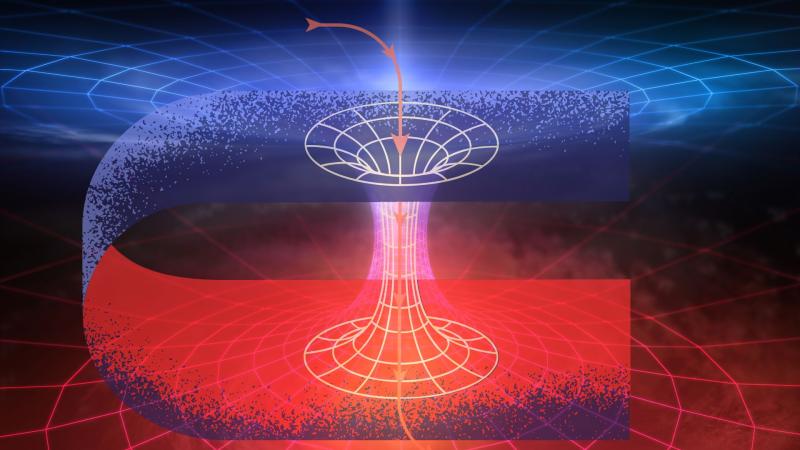
Scientists have theorised a new, stable blueprint for a traversable wormhole, a shortcut through spacetime, by blending a modified theory of gravity with the physics of real-world gases. Researchers from the Birla Institute of Technology and Science Pilani, Hyderabad, used the f(R, L, T) gravity framework and the Van der Waals equation of state to create a mathematically sound model that, crucially, shows strong resistance to collapse, a key step toward assessing the physical viability of these theoretical structures.
Wormholes are hypothetical tunnels through spacetime that could link distant parts of the universe, allowing faster-than-light travel. Although hypothetical, many theorists have been working on how to create and sustain a wormhole long enough for information, or perhaps, a human, to travel through. The biggest hurdle in making a traversable wormhole is the need for exotic matter, which is hypothetical material with negative mass and energy, which violates the standard rules of Einstein's General Relativity (GR). The new research tackles this problem by using a modified gravity theory, which allows the required exotic behaviour to be generated by the geometry of spacetime itself, rather than solely by exotic matter.
Did You Know? Wormholes are different from black holes because they don't have an event horizon, meaning you could theoretically pass through them without being trapped. |
The team used f(R,L,T) gravity, a framework that extends General Relativity by allowing the geometry or curvature of spacetime (R) to interact directly with matter. According to quantum physics, all the different matter we see around us is vibrations in specific quantum fields, which can be represented using the Lagrangian (L). Finally, the energy-momentum tensor (T) provides a measure of the density of energy and momentum at a point in space.
This geometry-matter coupling is the mechanism that can potentially shift the burden of exotic matter from the fluid to the gravitational field. To model the matter inside the wormhole throat more realistically than a simple ideal fluid, they employed the Van der Waals equation of state. This equation, borrowed from classical thermodynamics and commonly used to describe real gases by accounting for particle size and attraction, is better suited for the extreme densities and pressures expected near a wormhole throat than simpler models.
The resulting wormhole solution passed all essential geometric tests: it had a minimal throat radius, satisfied the 'flaring-out' condition, meaning the throat opens up, and was 'asymptotically flat,' ensuring it connects to normal spacetime far away. Their solution was also tested using the Volume Integral Quantifier (VIQ), which measures the total amount of exotic matter required.
The researchers found that the VIQ is inversely proportional to the coupling strength, meaning that by simply increasing the strength of the geometry-matter interaction, the need for exotic matter can be minimised or even neutralised. This provides a clear theoretical pathway to constructing wormholes that are supported primarily by geometric effects rather than purely unphysical matter. The derived solution also self-consistently satisfies the Van der Waals equation of state and hydrostatic equilibrium, a level of compatibility often missing in previous models.
While traversable wormholes remain firmly in the realm of theoretical physics, this research provides a crucial step in understanding the fundamental nature of gravity. By demonstrating that physical matter (a Van der Waals fluid) can support a stable wormhole within a modified gravity framework, the study opens new avenues for interpreting the universe. This broadens the scope for future theoretical exploration beyond standard general relativity. Future work will focus on calculating the potential astrophysical signatures of these wormholes, such as their gravitational lensing effects and the size and shape of their 'shadows,' which could one day be compared against high-resolution observations to guide the search for these cosmic shortcuts.
This article was written with the help of generative AI and edited by an editor at Research Matters.