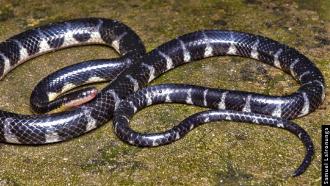
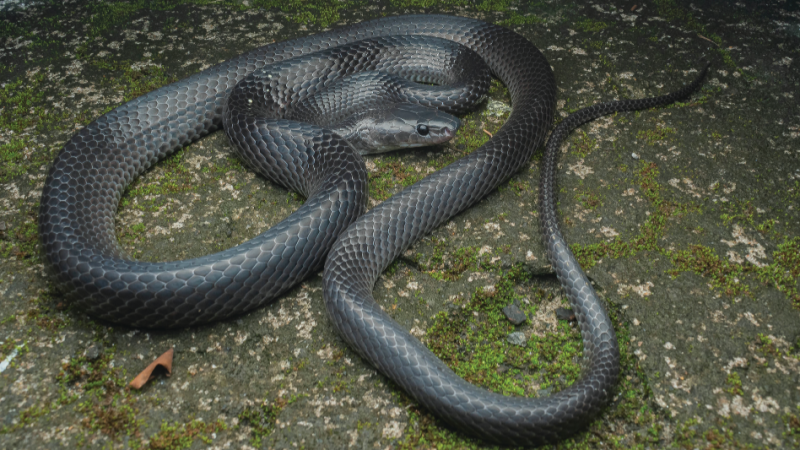
Image: Lycodon irwini. Credit: Authors, https://doi.org/10.3897/evolsyst.9.170645
Researchers have identified a new species of glossy black wolf snake, Lycodon irwini, on the remote Great Nicobar Island at the southern tip of the Nicobar Islands. The discovery confirms a distinct lineage that had been taxonomically unresolved for years. The snake, which is a member of the Lycodon subcinctus group, was named in honour of the late Australian conservationist and television personality, Stephen Robert Irwin.
Researchers from Pondicherry University and the Max Planck Institute for Biology in Germany confirmed the new species using a combination of morphological comparisons, re-examination of museum specimens, and molecular (DNA) analysis. Given its rarity and restricted habitat in the island’s moist evergreen forests, the authors recommend the new species be classified as 'Endangered' under the IUCN Red List criteria.
Lycodon irwini is a slender, fairly large, nocturnal snake, with a maximum known total length of nearly 1.2 metres. Its most distinguishing feature is its colouration: the snake is uniformly a glossy black on its back, a key difference from its close relatives in the L. subcinctus group, which typically have white bands across their dorsal surfaces. It can also be distinguished by a higher number of ventral scales (223–238) and subcaudal scales (78–94) compared to its closest relatives.
The discovery resolves a long-standing taxonomic mystery concerning the isolated snake population on Great Nicobar Island, which had previously been misidentified as the widespread Lycodon subcinctus. Molecular analysis based on mitochondrial and nuclear genes showed that the Nicobar wolf snake is genetically distinct, with an uncorrected pairwise sequence divergence of 6–17% from other members of the L. subcinctus group.
The Nicobar Archipelago, located in the Bay of Bengal, is a biodiversity hotspot renowned for its high rates of endemism, meaning many species are found nowhere else in the world. The new species is currently known only from four records, all from Great Nicobar Island, suggesting it is likely endemic to the island. The specimens were collected or observed in moist evergreen forest habitats, with the holotype—an adult female—collected near Gandhi Nagar.
The researchers chose the specific epithet irwini to honour Steve Irwin, noting that his "passion and dedication to wildlife education and conservation have inspired naturalists and conservationists worldwide." The finding highlights that the diversity and endemism of vertebrate species in tropical island regions, like the Nicobars, are still significantly underestimated, underscoring the need for continued conservation efforts.
This article was written with the help of generative AI and edited by an editor at Research Matters.