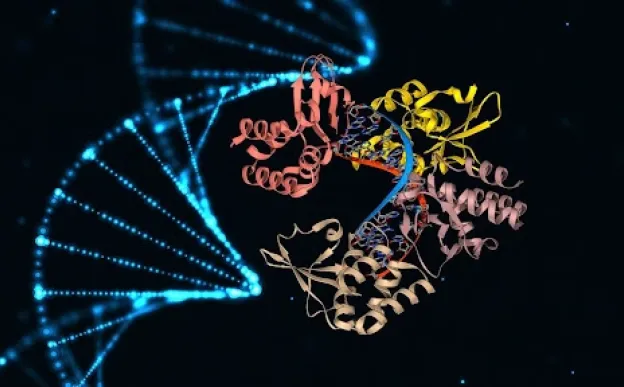
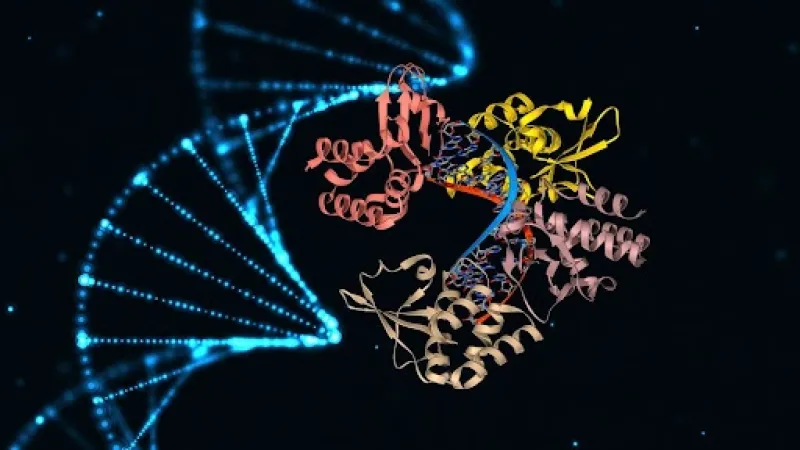
Deoxyribonucleic Acid or DNA is the blueprint for all life on earth. It is a molecule shaped like double-stranded helix whose primary function is to carry our genetic instructions. But is that all DNA does? A new study from researchers at the Indian Institute of Science Education and Research (IISER) Bhopal and the University of Denver reveals that DNA has a much more active, hands-on role in cellular health than previously thought. The study, describes how specific ‘knotted’ DNA structures act as molecular bodyguards or chaperones to help proteins fold correctly and prevent them from clumping into toxic piles.
Proteins form the structural foundations of life, but to function, they must fold into precise three-dimensional shapes. When they fail to fold correctly, they become misfolded and aggregate, a process that is a hallmark of many devastating conditions, including Alzheimer’s and Parkinson’s disease. While the body has specialised proteins called chaperones to assist in this process, this new research highlights that G-quadruplexes (G4s), four-stranded DNA structures formed by guanine-rich sequences, are actually some of the most efficient chaperones in existence.
To understand how these DNA structures perform their protective functions, the research team focused on a specific DNA sequence, Seq576. Using Nuclear Magnetic Resonance (NMR) spectroscopy, a technique that exploits the magnetic properties of atomic nuclei to determine the structure, dynamics, and chemical environment of molecules, they were able to peer into the structure of Seq576 at an atomic level. They discovered that this DNA sequence does not maintain a single fixed shape.Iinstead, it displays two distinct parallel configurations. By using the NMR method, the team was able to map these structures faster than traditional methods allow.
Did You Know? DNA isn't always a double helix. While we usually see it as a twisted ladder, it can fold into squares, knots, and even four-stranded structures called G-quadruplexes. |
The researchers then performed structure-function tests, which invovled breaking or changing small parts of the DNA to see which parts were essential for its functioning. They found that a specific part of the DNA structure, a protruding “propeller loop” containing a base called G17, was the key. When they mutated this specific spot, the DNA lost its ability to prevent proteins from clumping. Using the AI-based tool AlphaFold3, the team simulated the interaction and found that this G17 base essentially burrows into the protein, providing a stable surface that guides the protein into its correct shape.
Interestingly, they found that while the DNA was excellent at preventing proteins from clumping together (a role known as a holdase), it was also capable of actively helping already tangled proteins refold into their proper, functional states (a foldase role).
While earlier works had established that G-quadruplexes were efficient chaperones, they lacked the high-resolution structural detail to explain why. This study improves on that by providing a residue-level map, pinpointing the exact atoms responsible for the chaperone activity.
By identifying the exact structural features of DNA that prevent protein clumping, scientists may eventually be able to design synthetic DNA aptamers or drugs that mimic these natural chaperones. This could lead to new treatments for neurodegenerative diseases where protein aggregation is the primary cause of brain cell death.
This article was written with the help of generative AI and edited by an editor at Research Matters.