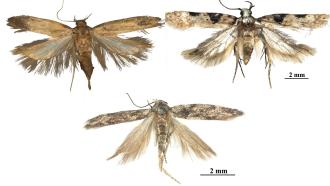
Researchers have discovered two new species of rare ant flies in India, marking the first time in over a century that new members of this rare and unusual insect group have been identified in the country. The discovery, made in the heart of the bustling capital of New Delhi and the lush forests of the Western Ghats in Tamil Nadu, reveals a world of insects that live their lives disguised as wasps while their larvae infiltrate ant nests.
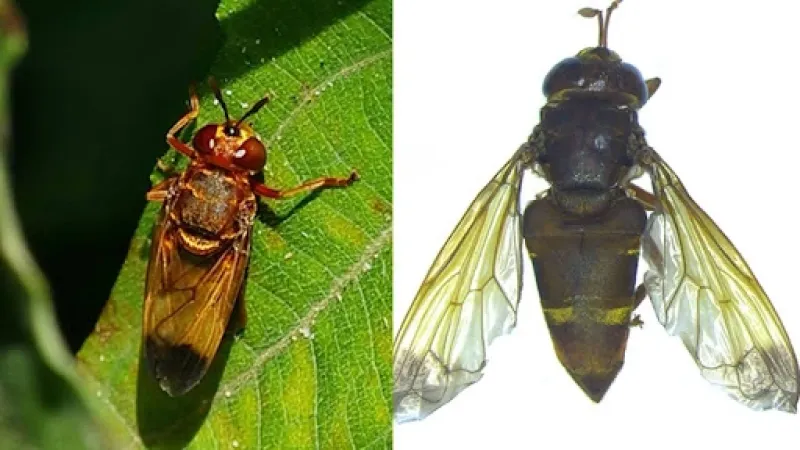
Researchers Hariharakrishnan Sankararaman, from Amrita Vishwa Vidyapeetham, and Sainulabdeen Sulaikha Anooj, from Kerala Agricultural University, identified the new hoverflies through a combination of field expeditions and genetic testing. The findings introduce the world to Metadon ghorpadei, found in the Delhi Ridge forest, and Metadon reemeri, discovered in the Siruvani hills of Tamil Nadu.
The discovery is particularly significant because this specific subfamily of flies, known as Microdontinae, has been almost entirely unstudied in India since the early 1900s. Unlike common hoverflies that visit garden flowers, these ant flies are rarely seen. Their larvae look like slugs and are obligate predators, meaning they live exclusively inside ant nests where they feast on ant eggs and babies.
To find these elusive insects, the team used sweep nets to capture adults perched on shrubs. They then used DNA barcoding, a method of reading an organism’s genetic fingerprint, to confirm that the flies were unique. This study provided the first-ever DNA barcodes for this group of flies in India, allowing the researchers to prove that the two species were genetically distinct from their closest relatives in Southeast Asia.
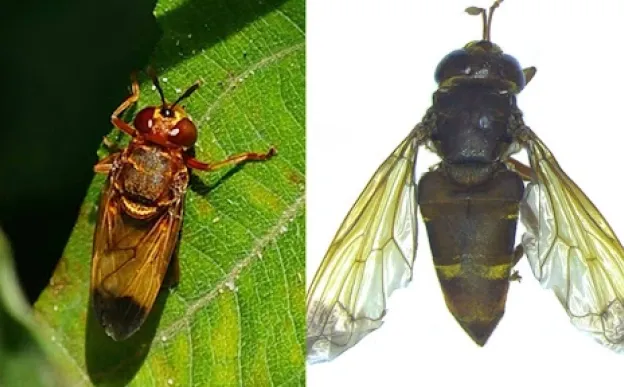
While both species are master mimics of stinging wasps, they have distinct physical characteristics that allow scientists to tell them apart. Metadon ghorpadei, named in honor of Indian fly expert Dr. Kumar Ghorpadé, is characterized by its pale brown antennae, entirely yellow legs, and a body covered in shimmering golden hair. Its southern cousin, Metadon reemeri, has blackish antennae and a more rugged appearance, with the top half of its hind legs being deep black.
Beyond the thrill of discovery, the researchers say the find carries a serious warning about conservation. The Delhi Ridge, where one of the flies was found, is a shrinking urban forest under heavy pressure from city expansion and human activity. Because these flies depend on specific ant colonies to survive, they are highly sensitive to changes in their environment.
The team hopes that the discovery of such rare and specialized insects in a major city like New Delhi will encourage authorities to protect these small pockets of nature. As Sankararaman and Anooj noted in their report, the survival of these secret ant-dwellers depends entirely on the health of the forests they call home.
This article was written with the help of generative AI and edited by an editor at Research Matters.