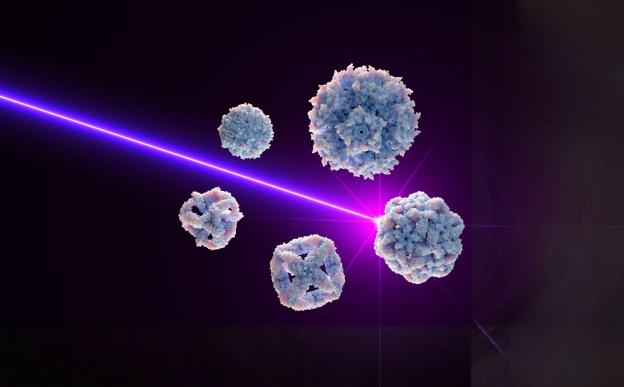
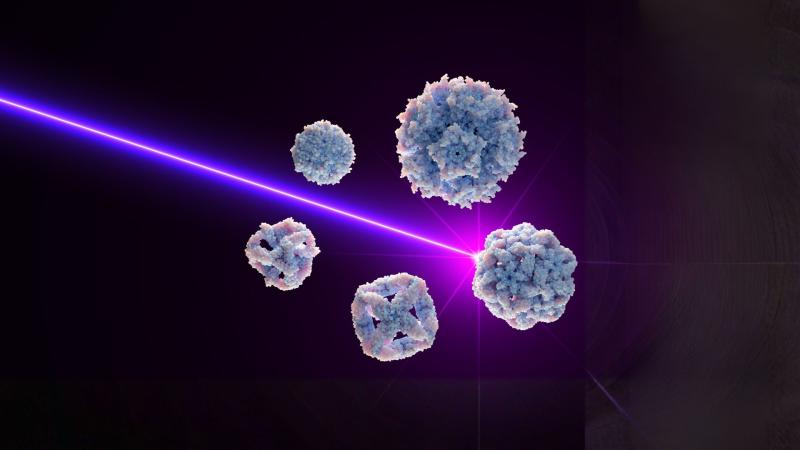
Researchers at the Indian Institute of Technology Guwahati have successfully demonstrated a method to engineer the microscopic phases of molybdenum oxide (MoO) nanoparticles, a material essential for the future of green energy and medicine. By using high-intensity lasers and controlled heating, the team showed that they can force these tiny particles to change their atomic structure, effectively switching their physical properties on demand. The study reveals that these nanoparticles are incredibly sensitive to external stimuli, allowing researchers to fine-tune them for specific tasks like killing cancer cells or storing electricity in supercapacitors.
Did You Know? Raman Spectroscopy, named after the Indian physicist Sir C.V. Raman, works by bouncing laser light off a material and measuring how the light's colour changes—a discovery that won him the Nobel Prize in 1930. |
The team used a process called Pulsed Laser Ablation in Liquid (PLAL) to create the MoO nanoparticles. They submerged a piece of high-purity molybdenum metal in distilled water and hit it with a powerful nanosecond laser. This ablates or erodes the metal, knocking off atoms that then react with the water to form a cloudy solution of molybdenum oxide. Unlike traditional chemical methods that require surfactants, essentially chemical soaps to keep the particles from clumping, the PLAL method is entirely clean and environmentally friendly.
Initially, the process produced a specific type of material, Mo8O23, a sub-stoichiometric phase. This version of the material has a high number of defects, including missing oxygen atoms. These defects, however, can be beneficial for technology. They make the material more reactive in chemical reactions and enable it to absorb light in the near-infrared spectrum. This specific light absorption is crucial for photothermal therapy, in which nanoparticles are injected into the body and heated with lasers to destroy tumours without harming surrounding healthy tissue.
The most significant finding occurred when the researchers began testing the stability of these particles. They probed the material using Raman spectroscopy, which uses light to fingerprint atomic vibrations. They found that increasing the laser power caused the nanoparticles to physically transform. At a power of 20 milliwatts, the atoms began to rearrange themselves. By the time the laser reached 40 milliwatts, the material had completely transformed into a more stable form known as α−MoO3. The team confirmed this was caused by heat by placing the particles in a furnace. They found the same transformation happened naturally between 250°C and 400°C.
Ultimately, this research moves us closer to a lab-on-a-chip future. The ability to use lasers to trigger structural changes at the microscale means we could one day create smart sensors that adapt to their environment or more efficient lithium-ion batteries that last longer and charge faster. By mastering the ability to engineer these materials with light, scientists are opening a new door to cleaner technology and more precise medical tools.
This article was written with the help of generative AI and edited by an editor at Research Matters.