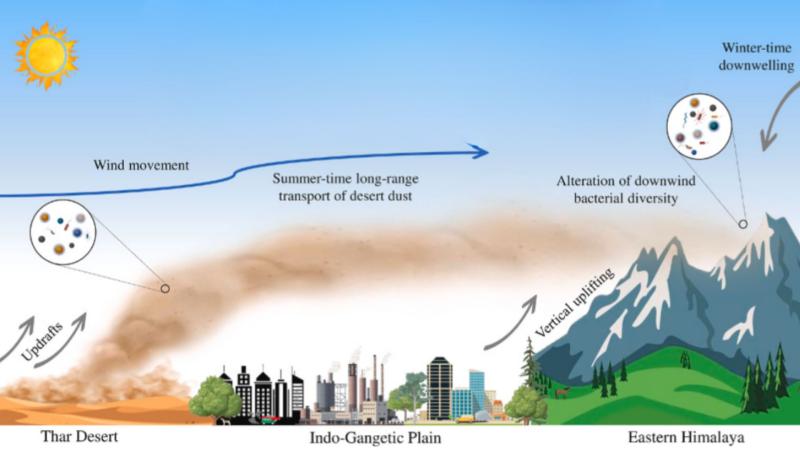
Image: Graphical representation of dust and microbe transport. Credit: Authors, https://doi.org/10.1016/j.scitotenv.2025.180981
The Himalayas are known as a sanctuary of pristine, crisp air, far removed from the pollution and dust of the plains below. However, new research has called this narrative into question, indicating that the air over these majestic mountains is far more crowded and potentially dangerous than previously thought. A team of researchers from the Bose Institute in Kolkata and the Indian Institute of Tropical Meteorology in Pune has discovered that the atmosphere over the Eastern Himalayas is being periodically invaded by legions of bacteria hitching rides on dust particles. These microscopic travellers are long-distance voyagers arriving from the Thar Desert, thousands of kilometres to the west. They leave a distinct biological footprint that could have significant implications for public health in the region.
The study, centred on the high-altitude hill station of Darjeeling, details how atmospheric circulation patterns act as a global conveyor belt for the bacteria. While the harsh conditions of the atmosphere, like the intense ultraviolet radiation, extreme dryness, and lack of nutrients, usually kill bacteria, dust particles provide a survival mechanism. The mineral dust acts like a microscopic dust umbrella, offering the bacteria shade from UV rays and maintaining just enough moisture to keep them alive during their journey across states.
Did You Know? When studying air, there is so little DNA present that scientists have to be careful not to sequence the DNA contaminants found in their own laboratory kits, referred to as Kitome problem |
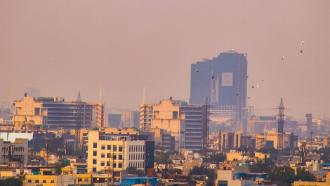
The research team set up an atmospheric observatory on a rooftop in Darjeeling, roughly 2,200 meters above sea level. Over two years, spanning 2022 and 2023, they collected air samples during the winter and pre-monsoon summer seasons. They also collected data on specific dusty days when satellite data indicated heavy aerosol activity. They got their data mainly from NASA’s CALIPSO and MODIS systems, both Earth-observing satellites that provide complementary data on aerosols and clouds.
The team used devices called Scanning Mobility Particle Sizers, which measure the size and concentration of aerosols in the air. They used these devices to count and measure physical dust particles while simultaneously employing DNA sequencing targeting the 16S rRNA gene to identify the bacterial species present. This method, known as metagenomics, allowed them to read the unique signature of the different bacteria to see precisely who was arriving and from where.
The researchers identified three distinct seasons of bacterial biodiversity. In the winter, the air was cleanest, dominated by local bacteria settling down from the free troposphere above. In the summer, the heat caused air from the populated foothills to rise, a process called upwelling, carrying pollution and respiratory pathogens up the mountain. But the most dramatic change occurred on dusty days. During these events, the total number of bacteria in the air skyrocketed. The study found that long-range transport accounted for 80% of the total bacterial population in the Himalayan air. Dusty days introduced 41% of unique bacterial species not found at other times.
By analysing the dust's chemical composition, the researchers also confirmed the invaders' source. They looked for specific chemical tracers; elements like aluminium and silicon are fingerprints of dust from the crust, while lead and zinc are markers of vehicular pollution. On dusty days, the samples were rich in aluminium and silicon and correlated perfectly with wind trajectories blowing in from the Thar Desert. Conversely, summer samples were rich in anthropogenic pollutants, confirming they originated from the urbanised Indo-Gangetic Plain below.
Earlier research has documented microbes being transported by dust from the Sahara to the Americas or from the Gobi Desert to Japan. Still, the complex terrain of the Himalayas had remained largely unexplored. This study is among the first to provide a comprehensive, multi-year analysis that combines ground-based DNA sampling with satellite observations to track these plumes in real-time. It also successfully differentiates between local pollution rising from the valleys and remote pollution arriving via high-altitude wind corridors.
However, while the researchers could identify the DNA of these pathogens, the presence of DNA does not always guarantee that every bacterium is active and capable of causing infection, though the dust shielding effect makes their survival highly probable.
The study has revealed that the type of health risk changes with the wind. Local upwelling pollution in summer can introduce bacteria associated with respiratory infections. In contrast, the long-range dust from the Thar Desert was found to carry a high bacterial load associated with skin infections. By monitoring weather patterns and dust storms, authorities could predict spikes in specific types of illnesses, advising vulnerable populations to take particular precautions. This research also highlights the need to treat the atmosphere as a dynamic ecosystem that connects distant deserts to snowy peaks.
This article was written with the help of generative AI and edited by an editor at Research Matters.