Astronomers using a massive radio telescope in India have made a breakthrough in understanding the noise that can interfere with our most sensitive observations of the universe. By analysing data from the Indian Pulsar Timing Array, the team successfully identified two distinct causes of mysterious signals recorded from distant pulsars, rapidly rotating neutron stars that emit beams of electromagnetic radiation (radio waves, X-rays, etc.) from their magnetic poles. One disruption was caused by a massive cloud of plasma erupting from our own Sun, while a sudden internal change within the pulsar itself triggered the other. These findings, published on arXiv, are crucial for scientists attempting to use pulsars as a giant, galaxy-sized laboratory to detect gravitational waves, which are ripples in spacetime caused by massive cosmic events.
Did You Know? Pulsars are so dense that a single teaspoon of their material would weigh about a billion tons—roughly the weight of Mount Everest! |
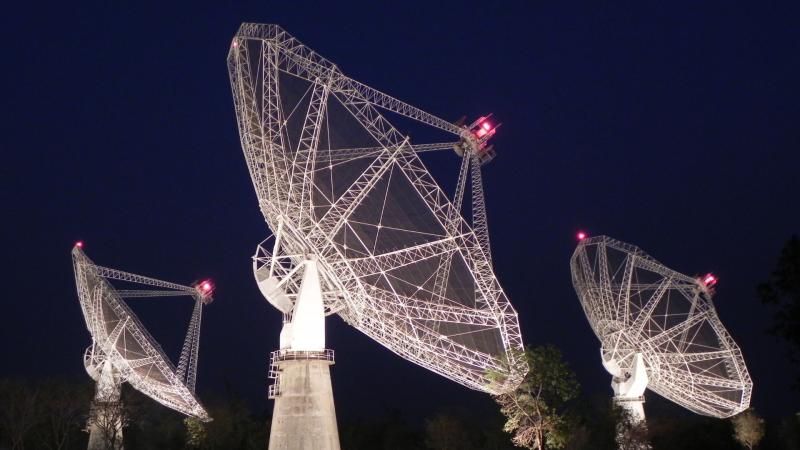
The study focused on two specific pulsars, the collapsed cores of giant stars that spin hundreds of times per second, acting as highly precise cosmic lighthouses. Because they emit radio beams at incredibly regular intervals, any delay in their signal can tell scientists about the environment between Earth and the star. However, occasionally these cosmic clocks show anomalies or outliers that don't fit the expected patterns. The research team, which included Indian and international colleagues, used the upgraded Giant Metrewave Radio Telescope (uGMRT) near Pune, which consists of 30 massive dish antennas, each spanning 45 meters in diameter, and spread over an area of 25 kilometres. The team used the uGMRT to investigate why these specific timing errors occur.
In the case of the pulsar named PSR J1022+1001, the researchers found that a sudden spike in signal delay on August 9, 2022, was not a problem with the star, but rather a result of space weather. By cross-referencing their data with NASA and ESA solar satellites, they confirmed that a Coronal Mass Ejection (CME), a massive blast of charged particles from the Sun, had crossed the line of sight between the telescope and the pulsar. The electron fog from this solar storm slowed the pulsar's radio waves, causing a temporary delay. This marks one of the first times scientists have captured such a clear, direct signature of a solar storm affecting a pulsar timing experiment.
Conversely, when the team looked at a second pulsar, PSR J2145−0750, they discovered a very different phenomenon. Instead of an external storm causing a delay, the star itself appeared to change its tune. This is known as a mode change, where the pulsar’s magnetic environment shifts, causing the shape of its radio pulse to transform. By carefully measuring the ratio of the peaks in the radio signal, the researchers proved that this was an internal reboot of the star’s radio emission rather than an interference from our solar system.
Instead of simply cleaning the data, this research provides a physics-based framework to identify exactly what caused the disruption and data anomalies. Knowing the difference between a solar storm and a pulsar mode change allows scientists to tune their instruments to detect gravitational waves more accurately. However, the researchers note that data from solar satellites were incomplete during the CME event. They also note that higher-resolution observations are needed to determine whether the pulsar's magnetic polarisation changed during its mode shift.
The research improves our understanding of space weather and the behaviour of pulsars. Learning how solar storms affect deep-space signals helps us build better models to predict their behaviour. Furthermore, by refining our ability to detect gravitational waves, this work brings us closer to understanding the fundamental laws of gravity and the history of our universe.
This article was written with the help of generative AI and edited by an editor at Research Matters.