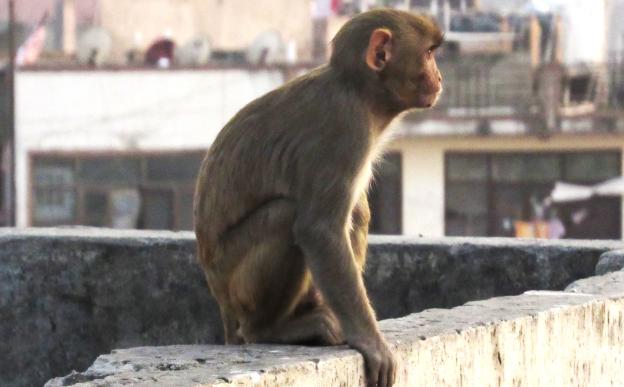
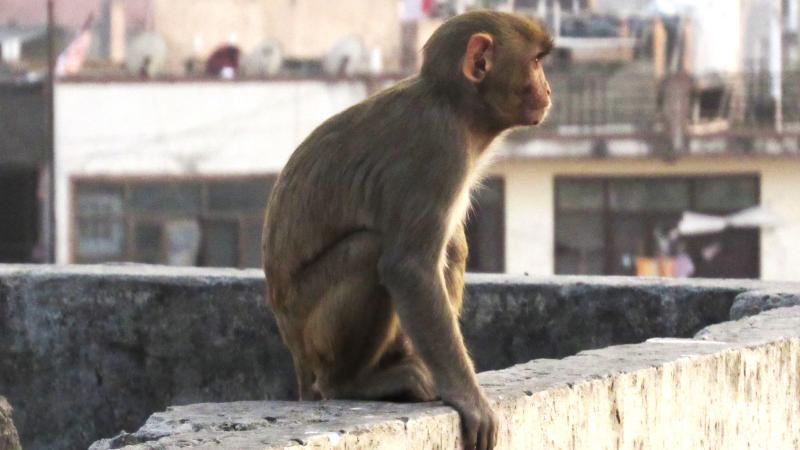
News study by researchers at the Wildlife Institute of India have developed a genetic barcode that allows them to identify rhesus macaques (Macaca mulatta) without ever having to touch or disturb the animals. By creating two new species-specific primers, which are short stretches of DNA that are unique for a specific animal, the research team can now confirm the presence of these primates using nothing more than a stray hair or a piece of fecal matter found on the forest floor. The study provides a vital tool for ecologists and conservationists working in dense, mixed-species habitats where telling one monkey from another can be a challenging task.
Did you know? Rhesus macaques were some of the first astronauts. A macaque named Albert II became the first primate in space when he reached an altitude of 83 miles in a V-2 rocket in 1949. |
The team used a specific part of the genetic code, mitochondrial DNA, and a gene known as cytochrome b. While most DNA is found in the cell’s nucleus, mitochondrial DNA is often preferred for field studies because it is more abundant and survives longer after an animal has left a sample behind. The researchers focused on the cytochrome b gene because it remains highly conserved across all rhesus macaque individuals but shows distinct differences compared to other closely related monkeys. By identifying these unique differences, the team designed two primer pairs, named Mmu1 and Mmu2. These primers are designed to bind to the rhesus macaque's DNA during a process called Polymerase Chain Reaction (PCR), which amplifies millions of copies of a specific DNA segment so it can be easily identified.
To ensure the test was foolproof, the team conducted rigorous in silico (computer-based) and in vitro (laboratory) testing. They tested the primers against DNA from eight other species, including five macaque species, gibbons, langurs, and even humans. The results showed that the Mmu1 and Mmu2 primers only reacted with rhesus macaque DNA and ignored all other species.
This level of precision is critical because in the wild, rhesus macaques often live alongside bonnet macaques or other primates whose droppings and hair look identical to the naked eye. Furthermore, the team tested the markers on 60 faecal samples of varying ages collected from the Dehradun region of India. Even in old, dried-out samples where the DNA had begun to degrade, the test remained highly effective, with a 80% to 93% success rate.
These markers are designed for species identification only and cannot tell individual monkeys apart or identify specific family relationships. Additionally, because the markers are mitochondrial, they might struggle to accurately identify hybrids, monkeys that are a mix of two different species, due to a biological phenomenon where one species’ mitochondrial DNA can bleed into another’s population over generations.
Nevertheless, this non-invasive genetic toolkit allows for large-scale monitoring of wild populations, helping researchers understand how these monkeys adapt to urban environments and how to better manage human-wildlife conflict. By making species identification accessible and affordable, the study empowers conservationists to protect biodiversity more effectively in the rapidly changing landscapes of the modern world.
This article was written with the help of generative AI and edited by an editor at Research Matters.