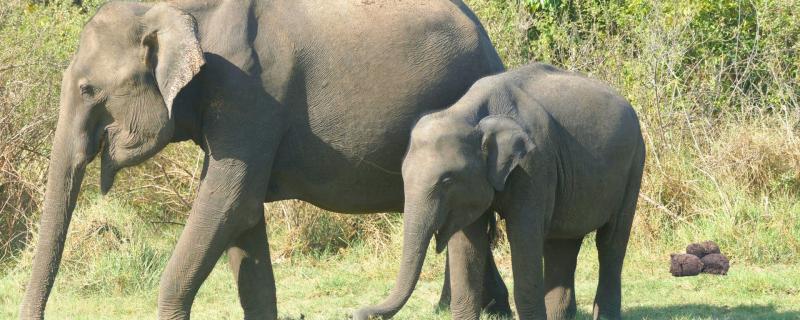
New research from India reveals that, contrary to long-held scientific beliefs, feeding on trees and shrubs does not provide Asian elephants with more protein than grazing on grass.

News

Dehradun

Researchers used genetic tracking and spatial modelling to overcome the limitations of dung counts, providing a reliable census of Asia's threatened elephants.

USA

A newly observed gravitational wave event from the collision of two massive, rapidly spinning black holes forces scientists to reconsider how these cosmic giants are born and grow.

Chennai

Pilia, an enigmatic genus of jumping spider has just been rediscovered in the tropical forests of Western Ghats after a staggering 123 years. The find has not only led to the description of a brand-new species, Pilia malenadu, but,  also allowed researchers to document the first-ever female of the entire genus.

Goa

Synergistic pressures from land use changes and climate extremes are the primary drivers behind a worrying decline in the Western Ghats' ability to absorb carbon.

Thiruvananthapuram

Researchers from IISST used simple polymethyl methacrylate (PMMA) to partially correct a turbulent laser beam and restore its statistical order.

Yercaud

A new zoological discovery has been announced, with the description of a new genus and species of freshwater crab belonging to the family Gecarcinucidae.

Bengaluru

Frog and toad communities remain surprisingly stable across both urban and rural settings, suggesting increased resilience or a lag phase with effects yet to be observed. Loss of habitat and pollution, a worry.

Arunachal Pradesh

A new discovery has added six butterfly species previously unrecorded in India, with one, the Litin Onyx, known only from Laos, representing a massive range extension into the Eastern Himalayas.

Kharagpur

Ecological droughts are on the rise in India's pristine forests and croplands, driven primarily by meteorological aridity and ocean warming, posing a major threat to the country's sustainability and food security.

Bhopal

New research reveals India's forest monitoring fails to capture social and economic health, leading to a comprehensive new blueprint that include vital social and economic dimensions and introduces a comprehensive list of 28 indicators and 64 sub-indicators to create a robust, evidence-based system for monitoring and reporting.
.

Search Research Matters